The Adam’s Forward Bend Test is the standard physical screen for scoliosis. The person bends forward from the hips while an observer looks along the back for asymmetry — a raised rib hump or a fuller side of the lower back. Adding a scoliometer turns what the eye sees into a number.
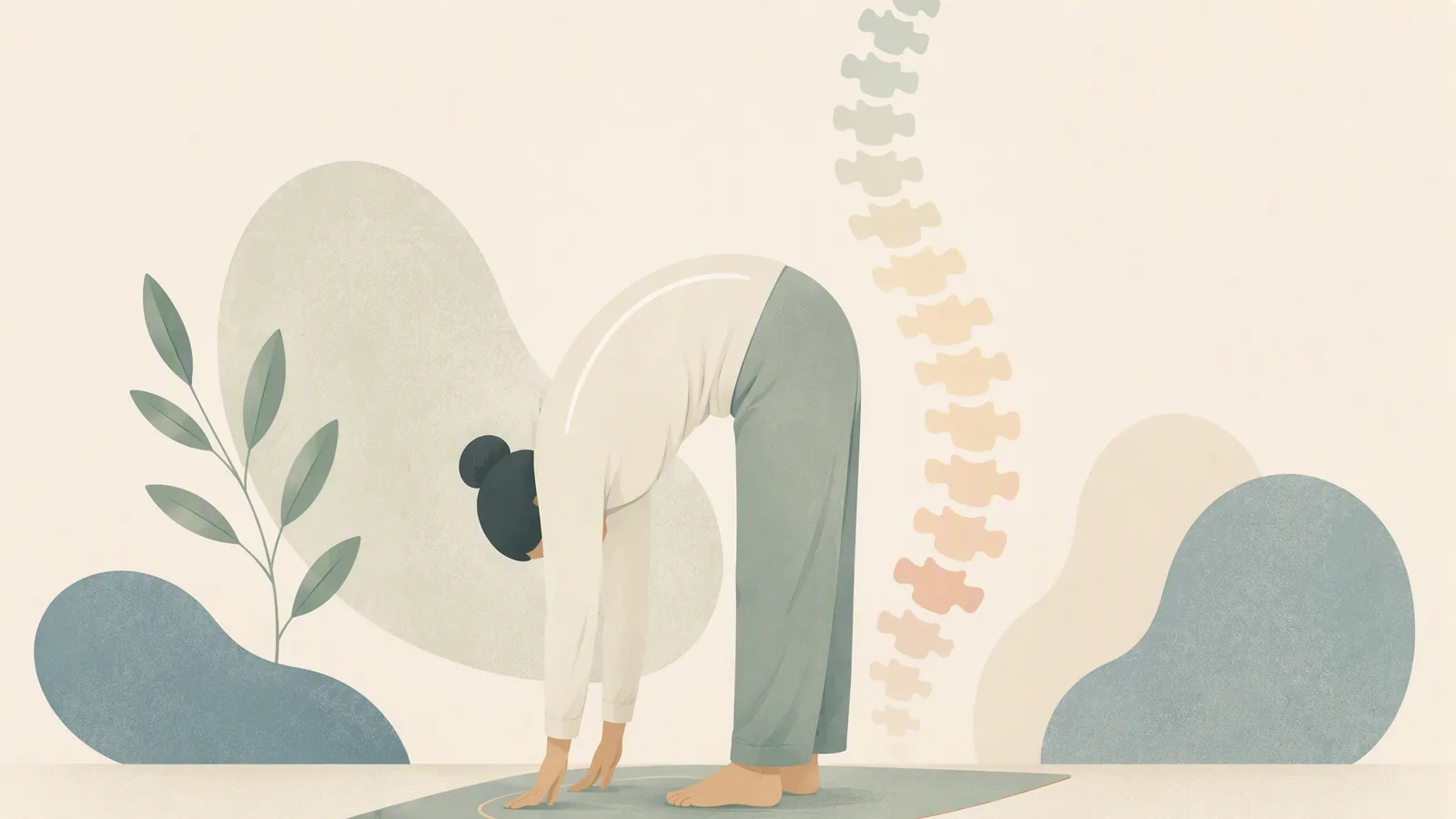
Described by William Adams in the nineteenth century, the forward bend test remains the most widely used first-line screen for scoliosis in schools and clinics because it is quick, needs no equipment and involves no radiation. It also has real limitations that anyone using it should understand: it detects rotation, it depends heavily on technique, and it neither diagnoses scoliosis nor rules it out.
What the test is looking for
In scoliosis the vertebrae rotate as well as curve sideways. That rotation carries the ribs backwards on one side of the chest and the paraspinal muscles backwards on one side of the lower back. Standing upright, this can be subtle. Bending forward removes much of the compensation, and the raised side becomes visible as a rib hump in the upper back or a lumbar prominence in the lower back.
What the observer is judging is whether the two sides of the back sit at the same height. A scoliometer laid across the back at the point of greatest difference converts that judgement into degrees, which is what makes the result recordable and comparable over time.
How to perform the test
- Prepare the setting. A level floor, good lighting, shoes off, and enough of the back exposed to see the spine and both sides of the trunk. A vest or swimsuit top works well for children.
- Start standing. Feet together, knees straight, arms at the sides, weight even. Note anything visible at this stage: shoulder height, shoulder blade prominence, waist creases, head position over the pelvis.
- Ask the person to bend forward slowly from the hips. Arms hang loose with palms together, head and neck relaxed, knees straight. They stop when the back is roughly horizontal — not a full toe-touch.
- Observe from behind, at the level of the back. Crouch or sit so you are looking along the surface of the back rather than down onto it. Compare the two sides at the upper back, mid back and lower back.
- Measure with a scoliometer if you have one. Rest it flat across the back, perpendicular to the spine, centred over the spinous processes. Move slowly from the upper back down to the lower back, pausing at each region.
- Record the highest reading and its location. “8°, right thoracic” is far more useful in six months than “8°”. Note the date and who took the measurement.
- Observe from the side as well. While the person is bent forward, an unusually rounded upper back may point to kyphosis rather than scoliosis, which is a different finding and worth mentioning to a clinician.
Interpreting what you see and measure
| Finding | What it may suggest | Usual next step |
|---|---|---|
| Back looks level; ATR below 5° | No obvious trunk asymmetry on this screen | Routine monitoring, especially through growth spurts |
| Slight difference; ATR 5°–6° | Mild asymmetry worth watching; the referral point for children with obesity, in whom curves are harder to see | Re-measure carefully; consider professional review |
| Clear hump or prominence; ATR 7° or more | The commonly accepted referral threshold in screening programs | Seek professional assessment |
| Reading rising by 2° or more over time | Possible progression, regardless of the absolute value | Seek professional review |
| Low reading but visible asymmetry, pain or family history | The screen may not have captured the problem | Seek professional review anyway |
Limitations you should know about
- It detects rotation, not curvature. A curve with little rotational component can produce a modest reading. The test can miss curves it was never designed to see.
- It cannot diagnose. A diagnosis of scoliosis requires clinical examination and usually imaging, where the Cobb angle is measured. See ATR versus Cobb angle.
- Results depend on the observer. Between-tester variation is the single largest source of inconsistency, which is why the same person should take repeat measurements where possible.
- Body composition affects visibility. Asymmetry is harder to see in children who are overweight, which is why a lower referral threshold is commonly used for them.
- Bend depth changes the result. Too shallow and the rotation is not yet exposed; a full toe-touch rounds the spine and can flatten it.
- It says nothing about cause or progression risk. Age, skeletal maturity and growth stage matter more than any single reading.
- A normal result is not a clearance. Symptoms, visible changes or a family history still deserve professional review.
Using the test at home, in school and in clinic
Parents
The forward bend test is simple enough to do at home and is a reasonable way to monitor between appointments — roughly every two to four weeks through a growth spurt. Keep the setup identical each time and write every reading down with its date. The aim is not to diagnose your child, but to notice a change early enough to act on it.
School screening
Screening programs typically combine the forward bend test with a scoliometer so that referral decisions rest on a recorded number rather than an impression, and so that findings are consistent between screeners. Documenting the reading, the region and the screener makes follow-up far easier. A written record also helps parents understand why a referral was or was not made.
Clinicians
In practice the test is one element of a broader examination that includes posture, shoulder and pelvic levels, leg length, neurological screening, growth status and history. A digital scoliometer adds a time-stamped record that can be reviewed alongside imaging intervals and reduces reliance on recalled impressions.
When to seek professional review
Book an assessment if a reading reaches the referral threshold, if readings are climbing across measurements, or if you notice uneven shoulders, a prominent shoulder blade, an uneven waistline, a visible rib hump on forward bending, or back pain that is persistent or waking the person at night. Outcomes vary between individuals; a professional examination is what establishes the meaning of a screening result for a specific person.
Download the Scoliometer App
Available on iPhone and Android.

 Trusted by clinicians and families in 75+ countries.
Frequently asked questions
- What is the Adam’s Forward Bend Test?
- A physical screening test in which a person bends forward from the hips while an observer looks along the back for asymmetry caused by trunk rotation. It is the standard first-line screen for scoliosis.
- How far should the person bend forward?
- Until the back is roughly horizontal, with arms hanging freely and knees straight. A full toe-touch rounds the spine and can hide the rotation the test is designed to reveal.
- Can the forward bend test diagnose scoliosis?
- No. It is a screening test. A diagnosis requires professional examination and usually imaging, where the Cobb angle is measured.
- Can the test miss scoliosis?
- Yes. It detects trunk rotation, so a curve with little rotational component may produce a modest reading. A low result with visible asymmetry, pain or family history still warrants review.
- Can parents perform it at home?
- Yes, with a second person to observe and measure. Keep the setup identical each time and record every reading with a date so that the trend, not a single number, guides the decision to seek review.
- Do I need a scoliometer to do the test?
- No, but a scoliometer converts a visual impression into degrees, which makes the result recordable and comparable over time. A smartphone scoliometer app performs the same measurement using the phone’s sensors.
Reference: van West HM, Herfkens J, Rutges JPHJ, Reijman M. The smartphone as a tool to screen for scoliosis, applicable by everyone. European Spine Journal 2022;31(4):990–995. The study measured 50 adolescents already diagnosed with idiopathic scoliosis (44 girls; mean age 14.1 years; mean Cobb angle 38.5°) at a hospital outpatient orthopaedic clinic, not children being screened at home. It validated smartphone-based ATR measurement as a method rather than any bespoke scoliosis app.

