Canada stopped checking children’s spines at school years ago, and whether that was the right call is still being argued. In the meantime, the check falls to parents. This guide explains how to do it, what the number means, and when it warrants a doctor.
Canada used to screen, and stopped
School scoliosis screening operated across Canadian provinces and was discontinued. The reasoning at the time echoed decisions made elsewhere: the screening test flags many more children than ultimately need treatment, and each referral carries costs in imaging, appointments and family anxiety.
That conclusion has not gone unchallenged. The Canadian Scoliosis Screening Coalition campaigns for reinstatement, arguing that early detection widens the range of non-surgical options and that the curves being missed are the ones that end up in operating theatres. The debate has had national media attention.
Both positions are held by serious clinicians, and this page takes neither side. What matters for you is the practical consequence, which is not in dispute: in Canada today, if a curve is going to be caught early, a parent is usually the one who catches it.
When to look
Adolescent idiopathic scoliosis appears and progresses during the growth spurt. That means roughly ages 10 to 14, earlier in girls than boys, and it is painless in the early stages — so there is nothing to prompt you unless you go looking.
It is also the age at which children stop changing clothes in front of their parents, which is precisely why school programmes existed. A check every few months through those years is enough.
How to perform the test at home
- Position. Have your child stand with feet together and knees straight, back uncovered or in a swimsuit top. Good light and a clear view of the whole back matter more than anything else.
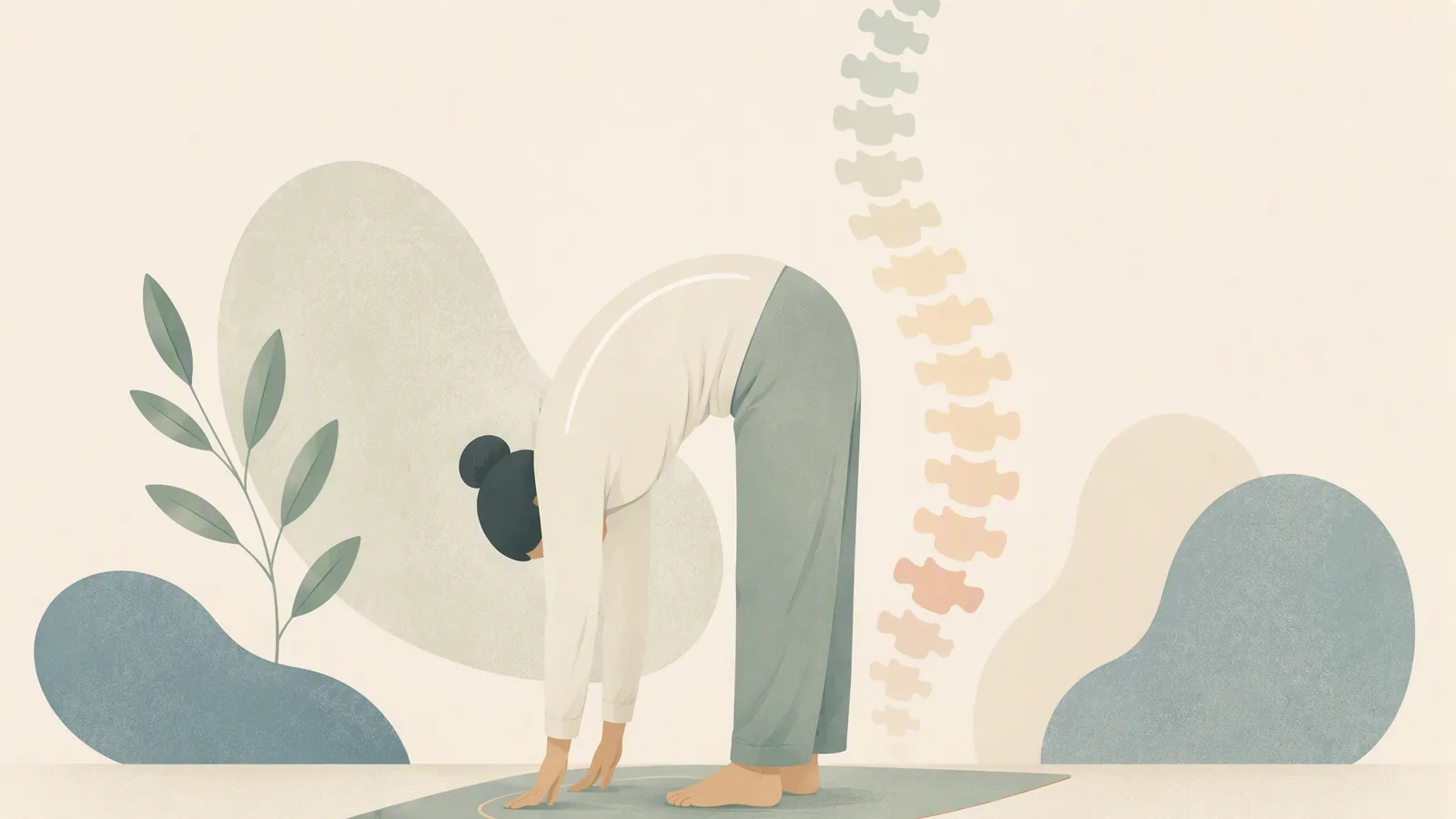
- Bend. Ask them to bend forward from the waist, arms hanging loose and palms together, until the upper back is roughly horizontal.
- Look before you measure. View from directly behind with your eyes level with the back. You are looking for one side sitting higher than the other — a rib hump in the upper back, or a fullness on one side of the lower back.
- Measure. Rest the scoliometer, or a phone running a scoliometer app, gently across the back at the highest point of asymmetry. Let it sit under its own weight; do not press.
- Work down the spine. Move from upper to lower back and record the largest reading, with a note of where you found it.
- Keep conditions identical. Same person measuring, same time of day, same technique. A series is only useful if the readings are comparable.
What the reading means
| Reading | What it suggests | What to do |
|---|---|---|
| Under 5° | Within the range seen in children without scoliosis | Re-check every few months through the growth spurt |
| 5° – 6° | Worth attention | Re-measure carefully; watch for any rise |
| 7° or more | The usual threshold for professional assessment | Book an appointment with your family doctor |
What the test cannot tell you
- It measures rotation, not curvature. A child can have a measurable curve on X-ray with relatively little surface rotation, and the reverse is also true.
- It does not produce a Cobb angle, and no app or scoliometer can convert one into the other reliably.
- It does not distinguish idiopathic scoliosis from other causes of trunk asymmetry, including leg length difference or postural habit.
- Readings vary between the people taking them, which is why one person should take every measurement in a home series.
- A normal reading is reassuring at that moment and says nothing about the next twelve months.
Seeing your doctor
Book an appointment if any of the following applies:
- A reading reaches 7° or more.
- Readings are climbing across measurements, particularly a rise of around 5°.
- You can see uneven shoulders, one shoulder blade standing out, an uneven waistline, or a visible rib hump on forward bending.
- Your child is in or approaching the growth spurt and a close relative has scoliosis.
- There is back pain that wakes your child at night, or any numbness or weakness — these are not typical of adolescent idiopathic scoliosis and need prompt review.
Your family doctor is the route to imaging and, where the Cobb angle warrants it, to a paediatric orthopaedic or spine service. Wait times for specialist assessment vary considerably by province, which is a practical argument for raising a concern early rather than watching for another six months.
Take your readings with you — dates, degrees and where on the back you measured. Because there is no screening record in the system, your notes may be the only history of the curve that exists. A trend over months is considerably more useful than a single number on the day.
Measure trunk rotation on your phone
Available on iPhone and Android.

 Trusted by clinicians and families in 75+ countries.
Frequently asked questions
- Do Canadian schools screen for scoliosis?
- Not routinely. School screening programmes operated across provinces and were discontinued. Some provinces or individual schools may run checks, but there is no national programme, so detection generally depends on a parent or clinician noticing something.
- Why was screening stopped?
- The reasoning followed the international pattern: the test flags many more children than ultimately need treatment, and each referral carries costs in imaging, appointments and family anxiety. Whether that trade-off was judged correctly is disputed — the Canadian Scoliosis Screening Coalition campaigns for reinstatement.
- Should I be worried that nobody is checking?
- Concerned enough to look, not worried. Most children have no curve, and most curves that exist are mild and stable. The point of checking is to catch the minority that progress while the range of options is still wide.
- How often should I check?
- Every three to six months through the growth spurt, roughly ages 10 to 14, is reasonable for a child with no findings. If you are watching a reading in the 5° to 6° band, measure more often and write every reading down.
- Does the app measure the Cobb angle?
- No. It measures the Angle of Trunk Rotation on the surface of the back. The Cobb angle is measured on an X-ray by a clinician and is the diagnostic measurement for scoliosis. No app can convert one into the other.
- Will my doctor order an X-ray?
- That is their clinical judgement. An X-ray is the only way to establish a Cobb angle, but it carries a radiation cost in a growing child, so it is not ordered on every raised reading.
- What if the wait for a specialist is long?
- Keep measuring while you wait, and keep the record. If readings rise noticeably during the wait, tell your family doctor — a documented change is the kind of information that can affect triage.
Sources. The discontinuation of Canadian school screening and the case for reinstatement are drawn from reporting on the Canadian Scoliosis Screening Coalition’s campaign, including CBC News coverage. Provincial arrangements and referral pathways vary and change over time; confirm current details with your family doctor or provincial health authority. Screening thresholds cited are those used in screening research generally, not a Canadian national standard. Results vary between individuals.

