Australia’s national approach to scoliosis detection puts the check in parents’ hands by design. If your daughter came home from school in Year 5 or Year 7 with a fact sheet about her spine, this page explains what you are being asked to do and how to do it properly.
Australia screens by asking parents to look
Most Australian states ran clinical school screening programmes once and abandoned them, largely on cost. What replaced them, from the early 1990s, is the National Scoliosis Detection Program — introduced and maintained by the Spine Society of Australia and endorsed by the Paediatrics and Child Health Division of the Royal Australasian College of Physicians.
The distinction matters. The programme is explicitly one of self-detection and parent education, not clinical screening. Schools distribute a fact sheet describing the outward signs of scoliosis and how to perform the forward bend test. Nobody examines the child at school. Follow-up happens only if a parent or the girl herself suspects something.
It targets girls aged 10 to 12 — Years 5 and 7 — because that is when adolescent idiopathic scoliosis typically first appears and when curves are most likely to progress.
What you are looking for
The fact sheet asks you to look for asymmetry. In practice that means:
- One shoulder sitting higher than the other.
- One shoulder blade standing out more prominently.
- An uneven waistline, or one hip appearing higher.
- The head not sitting centred over the pelvis.
- Most tellingly — a rib hump or lower-back fullness on one side when the child bends forward.
The forward bend is the important one, because rotation that is invisible when a child stands upright becomes obvious when they bend. That is the whole reason the test exists.
How to perform the test at home
The fact sheet describes the test in a paragraph. Here it is in the detail that actually makes it reliable.
- Position. Have your child stand with feet together and knees straight, back uncovered or in a swimsuit top. Good light and a clear view of the whole back matter more than anything else.
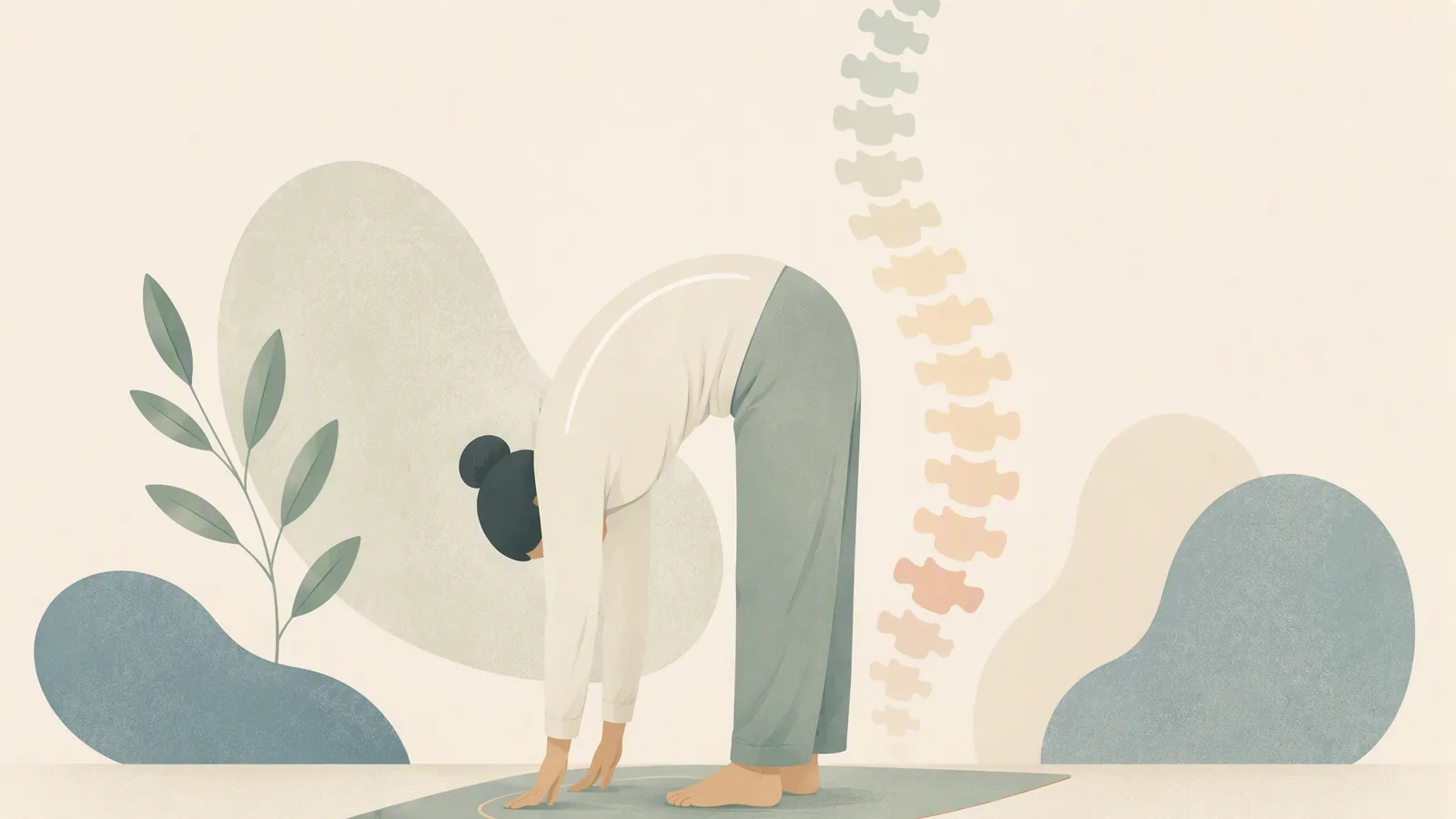
- Bend. Ask them to bend forward from the waist, arms hanging loose and palms together, until the upper back is roughly horizontal.
- Look before you measure. View from directly behind with your eyes level with the back, so you are sighting along it rather than down at it.
- Measure. Rest the scoliometer, or a phone running a scoliometer app, gently across the back at the highest point of asymmetry. Let it sit under its own weight; do not press.
- Work down the spine. Move from upper to lower back and record the largest reading, with a note of where you found it.
- Keep conditions identical. Same person measuring, same time of day, same technique. A series is only useful if the readings are comparable.
Adding a measurement to the programme’s visual check is the single biggest improvement you can make to it. “Looks a bit uneven” is hard to compare against last term. A number is not.
What the reading means
| Reading | What it suggests | What to do |
|---|---|---|
| Under 5° | Within the range seen in children without scoliosis | Re-check every few months through the growth spurt |
| 5° – 6° | Worth attention | Re-measure carefully; watch for any rise |
| 7° or more | The usual threshold for professional assessment | Book a GP appointment |
What the test cannot tell you
- It measures rotation, not curvature. A child can have a measurable curve on X-ray with relatively little surface rotation, and the reverse is also true.
- It does not produce a Cobb angle, and no app or scoliometer can convert one into the other reliably.
- It does not distinguish idiopathic scoliosis from other causes of trunk asymmetry, including leg length difference or postural habit.
- Readings vary between the people taking them, which is why one person should take every measurement in a home series.
- A normal reading is reassuring at that moment and says nothing about the next twelve months — which is why the programme targets a window rather than a single date.
Seeing your GP
Book an appointment if any of the following applies:
- A reading reaches 7° or more.
- Readings are climbing across measurements, particularly a rise of around 5°.
- You can see uneven shoulders, a protruding shoulder blade, an uneven waistline, or a visible rib hump on forward bending.
- Your child is in or approaching the growth spurt and a close relative has scoliosis.
- There is back pain that wakes your child at night, or any numbness or weakness — these are not typical of adolescent idiopathic scoliosis and need prompt review.
Your GP is the route to imaging and, where warranted, to a paediatric orthopaedic or spine service. Because the national programme relies on parents raising the concern, arrive ready to describe what you have seen rather than expecting to be asked.
Take your readings with you — dates, degrees and where on the back you measured. A trend over two or three terms tells a clinician something a single reading cannot.
What about boys?
The National Scoliosis Detection Program targets girls, because adolescent idiopathic scoliosis is more common in girls and more likely to progress. Boys do develop it. The technique is identical, the check costs nothing, and there is no reason not to look.
Measure trunk rotation on your phone
Available on iPhone and Android.

 Trusted by clinicians and families in 75+ countries.
Frequently asked questions
- Is scoliosis screened for in Australian schools?
- Not clinically. Most state school screening programmes were discontinued, and the National Scoliosis Detection Program replaced them with a self-detection approach: schools distribute a fact sheet and parents perform the check at home. Nobody examines your child at school.
- Who runs the National Scoliosis Detection Program?
- The Spine Society of Australia introduced and maintains it. It is endorsed by the Paediatrics and Child Health Division of the Royal Australasian College of Physicians.
- Why does it target Years 5 and 7?
- Girls aged 10 to 12 are in the window when adolescent idiopathic scoliosis typically first appears and when curves are most likely to progress. Catching a curve at the start of the growth spurt gives the widest range of options.
- The fact sheet says to look. Do I need to measure as well?
- Looking is the minimum and it is what the programme asks for. Measuring adds something looking cannot: comparability. “Slightly uneven” is impossible to compare against last term, whereas 4° against 6° is not.
- My son was not covered by the programme. Should I check him?
- Yes, if you have any reason to. Scoliosis is less common in boys and less likely to progress, but it occurs, and the technique is identical.
- Does the app measure the Cobb angle?
- No. It measures the Angle of Trunk Rotation on the surface of the back. The Cobb angle is measured on an X-ray by a clinician and is the diagnostic measurement for scoliosis. No app can convert one into the other.
- How often should I re-check?
- Every three to six months through the growth spurt is reasonable for a child with no findings. If you are watching a reading in the 5° to 6° band, measure more often and write every reading down.
Sources. Programme details, the self-detection design, the early-1990s introduction, the Years 5 and 7 target group and the RACP endorsement are from the Spine Society of Australia’s National Scoliosis Detection Program (Scoliosis Australia). Programme arrangements vary by state and change over time; confirm current details with your child’s school or the programme directly. Cited material describes screening methods, not any specific application. Results vary between individuals.

