Last reviewed: 15 August 2026. This guide is educational and does not replace individual assessment by a qualified clinician. Translations of this guide are made from this English original, which is the medically reviewed source.
A scoliometer gives you a number in degrees. That number is the Angle of Trunk Rotation (ATR) — how much one side of the back rises above the other when a person bends forward. It is a screening measurement of trunk asymmetry. It is not the Cobb angle, it is not a diagnosis, and the same number can mean different things for different people. This guide explains how to read the common thresholds — 5°, 7° and 10° — and what each should prompt you to do next.
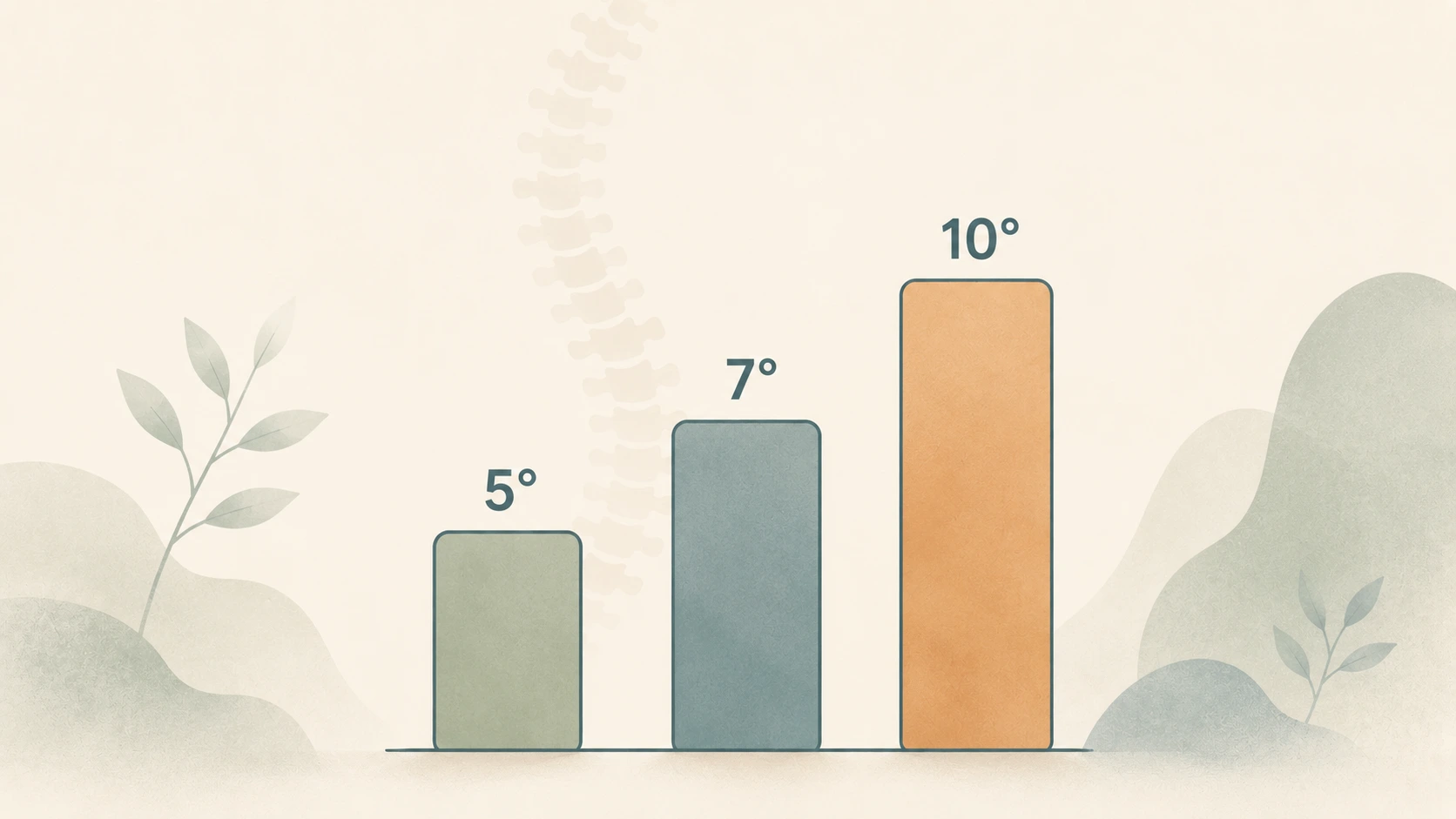
The short version. Below 5° is generally considered low. A reading in the 5°–6° band deserves attention and a careful re-check. 7° or more is the threshold most widely used to suggest professional assessment. A reading that climbs by 2° or more between measurements is worth reviewing even if the absolute number still looks modest.
A scoliometer is a screening aid. Only a clinician, usually with an X-ray, can confirm whether scoliosis is present and how large the curve is.
First, what the number actually is
When someone performs the Adam’s Forward Bend Test, any rotation in the spine lifts the ribs or the muscles on one side higher than the other. Rest a scoliometer — a physical one or the Scoliometer App on a phone — across the back at the highest point of that hump, and it reads the tilt in degrees. That tilt is the ATR.
Because the ATR measures the surface of the back rather than the bones themselves, it is an indirect signal. It correlates with the underlying spinal curve, but only loosely: across published studies the relationship between ATR and the radiographic Cobb angle sits at roughly r ≈ 0.7. In plain terms, a bigger ATR usually means a bigger curve, but you cannot convert one into the other with any precision. That is why the sections below talk about what to do at each reading, not what Cobb angle it “equals.” For the full comparison, see ATR vs Cobb angle.
The thresholds at a glance
| ATR reading | How it is generally read | Reasonable next step |
|---|---|---|
| 0°–4° | Low. Small asymmetries in this range are common and are frequently not associated with a significant curve. | Continue routine monitoring, especially through a growth spurt. Log the number so you can spot change. |
| 5°–6° | Borderline / attention. Meaningful enough not to ignore, but many readings here do not turn out to be a large curve. | Re-measure carefully (same person, same spinal level). This is the point at which many clinicians refer a child who is overweight, because soft tissue hides rotation. |
| 7°–9° | Raised. 7° is the most widely cited threshold for suggesting a professional look. | Arrange an assessment with a doctor, physiotherapist or chiropractor experienced in scoliosis. |
| 10°+ | Clearly raised. | Seek professional assessment. A reading this high still is not a diagnosis, but it warrants a proper evaluation, usually including imaging. |
| A repeated, confirmed rise between checks | Have it reviewed even if the current number looks moderate — the trend can matter more than any single reading. | |
These bands reflect commonly used screening conventions (the 7° threshold traces back to Bunnell’s work with the scoliometer). Different clinics and school programmes set their trigger point slightly differently, most often somewhere between 5° and 7°.
What does a 5° reading mean?
Five degrees sits right on the border. On its own it is not alarming, and a large share of 5° readings are not linked to a significant curve. But it is also the point at which a careful screener stops and pays attention rather than moving on.
Three things decide what a 5° should prompt:
- Repeatability. Take the measurement again. If a calm, careful re-check keeps landing near 5°, that is more meaningful than a single hurried reading that happened to show 5°.
- Body type. In a child who is overweight, soft tissue flattens the rib hump, so a “true” 5° can under-read — which is exactly why 5° is a common referral point in that group. In a very slim child the ribs stand out more, so a reading can slightly over-state the rotation.
- Growth. A 5° in a child who is in the fast part of a growth spurt deserves closer follow-up than the same number in an adult whose spine is no longer changing.
A sensible response to a steady 5° is not panic and not dismissal — it is to shorten the interval between checks and watch the trend. See screening during growth spurts for how often to re-measure.
What does a 7° reading mean?
Seven degrees is the number most screening guidance points to when deciding whether to involve a professional. It does not mean a curve is confirmed and it does not tell you the curve’s size — it means the trunk asymmetry is now large enough that a trained clinician should take a look.
Historically, a 7° ATR was described as corresponding on average to a Cobb angle in the region of 20°, the point at which many curves start to be actively monitored. That average hides a very wide spread from person to person, so treat “7° ≈ 20° Cobb” as a rough historical rule of thumb, not a conversion you can rely on for any individual. The practical takeaway is simpler: at 7° or above, arrange an assessment rather than waiting to see if the number climbs further.
What does a 10° reading mean?
Ten degrees is clearly raised and should prompt a professional evaluation without delay — but, importantly, it is still an ATR, not a Cobb angle and not a diagnosis. A clinician will typically examine the back, take a proper history and, where appropriate, order an X-ray to measure the actual curve.
It is worth keeping perspective at the same time as taking it seriously. Even among children referred with a raised reading, a large proportion of scoliosis follows an idiopathic pattern that is managed with observation, exercise or bracing — not surgery. A high reading is a reason to get answers, not a verdict.
Why the same number can mean different things
A scoliometer reading is only as good as the conditions it was taken in. The same person can produce different numbers depending on:
- Who is measuring and how. A different measurer, a different bend depth, or a device placed a centimetre off the apex can each shift the reading by a degree or two.
- Which spinal level. Rotation can occur in the upper (thoracic) and lower (lumbar) back. The reading that matters is the largest one found while scanning the whole spine, not the first level you happen to check.
- Body habitus. As above — more soft tissue tends to mask rotation; less soft tissue tends to reveal it.
- A single reading vs a trend. One number is a snapshot. A series of readings taken the same way over months is far more informative, which is the whole point of tracking with an app.
This is why careful technique matters so much. If your numbers jump around, work through how to use a scoliometer and the accuracy guide before drawing conclusions from any single figure.
How accurate is a phone reading in the first place?
Peer-reviewed research on smartphone-based ATR measurement has generally found good agreement with a physical scoliometer and good consistency when the same method is used carefully. Those studies assessed the ATR method across a range of smartphone apps and techniques; they were not clinical trials of any one specific application, including this one. So a phone can give you a reliable, repeatable ATR to screen and to track — but a raised or rising number is a prompt to see a professional, never a substitute for one.
Frequently asked questions
Is a scoliometer reading the same as the Cobb angle?
No. A scoliometer measures the Angle of Trunk Rotation on the surface of the back. The Cobb angle is measured from an X-ray of the spine. They are related but not interchangeable, and a scoliometer cannot give you a Cobb angle.
My child measured 5° — should I worry?
Five degrees is borderline rather than alarming, and many readings in this range are not linked to a significant curve. Re-measure carefully, keep a log, and shorten the interval between checks — especially during a growth spurt or if your child is overweight, where 5° is a common referral point.
Does 7° automatically mean scoliosis?
No. 7° is the threshold most screening programmes use to suggest a professional assessment, not a diagnosis. Only a clinician, usually with an X-ray, can confirm scoliosis and measure the curve.
What Cobb angle does a 7° or 10° reading equal?
There is no reliable conversion. On average a larger ATR goes with a larger Cobb angle (roughly r ≈ 0.7 across studies), but the spread between individuals is wide. Historically 7° was linked on average to around a 20° Cobb, but that should be treated as a rough rule of thumb only.
Why did I get a different number the second time?
Small differences in bend depth, device placement, which spinal level you measured, the measurer, and body position can each change the reading. Measure the whole spine and record the largest value, and try to keep the same person and technique each time.
Should I measure the top of the back or the lower back?
Both. Scan the whole spine while the person is bent forward and record the highest ATR you find. Rotation can appear in the thoracic (upper) or lumbar (lower) region.
How much change matters?
As a general guide, a reading that is higher on more than one occasion — measured the same way each time — is worth having reviewed, even if the current number still looks moderate. Repeat measurements of the same back can differ by several degrees, so a single higher reading is not by itself evidence of change. Trends are often more informative than a single reading.
Can adults use these same thresholds?
The 5°/7° convention comes from screening children and adolescents. Adults can absolutely use a scoliometer to screen and to track change, but the interpretation of a given number in an adult is best discussed with a clinician, since adult spines change for different reasons.
Track every reading over time
The Scoliometer App measures the Angle of Trunk Rotation and lets you log each reading, so you can watch the trend rather than react to a single number. A screening aid — not a diagnostic tool.


Medical disclaimer: This guide is for general education and screening awareness only. It is not medical advice and does not diagnose scoliosis or any spinal condition. A scoliometer — including a smartphone scoliometer — measures the Angle of Trunk Rotation as a screening aid; it is not the same as the Cobb angle, and it cannot replace an X-ray or professional assessment. Results vary between individuals depending on age, skeletal maturity, curve type, body build, measurement technique and how consistently readings are taken. Always consult a qualified healthcare professional about your own or your child’s spine.

