A scoliometer measures the Angle of Trunk Rotation (ATR) — the trunk asymmetry that appears when a person bends forward. It is a screening tool, not a way to diagnose scoliosis or measure the spine’s curve directly.
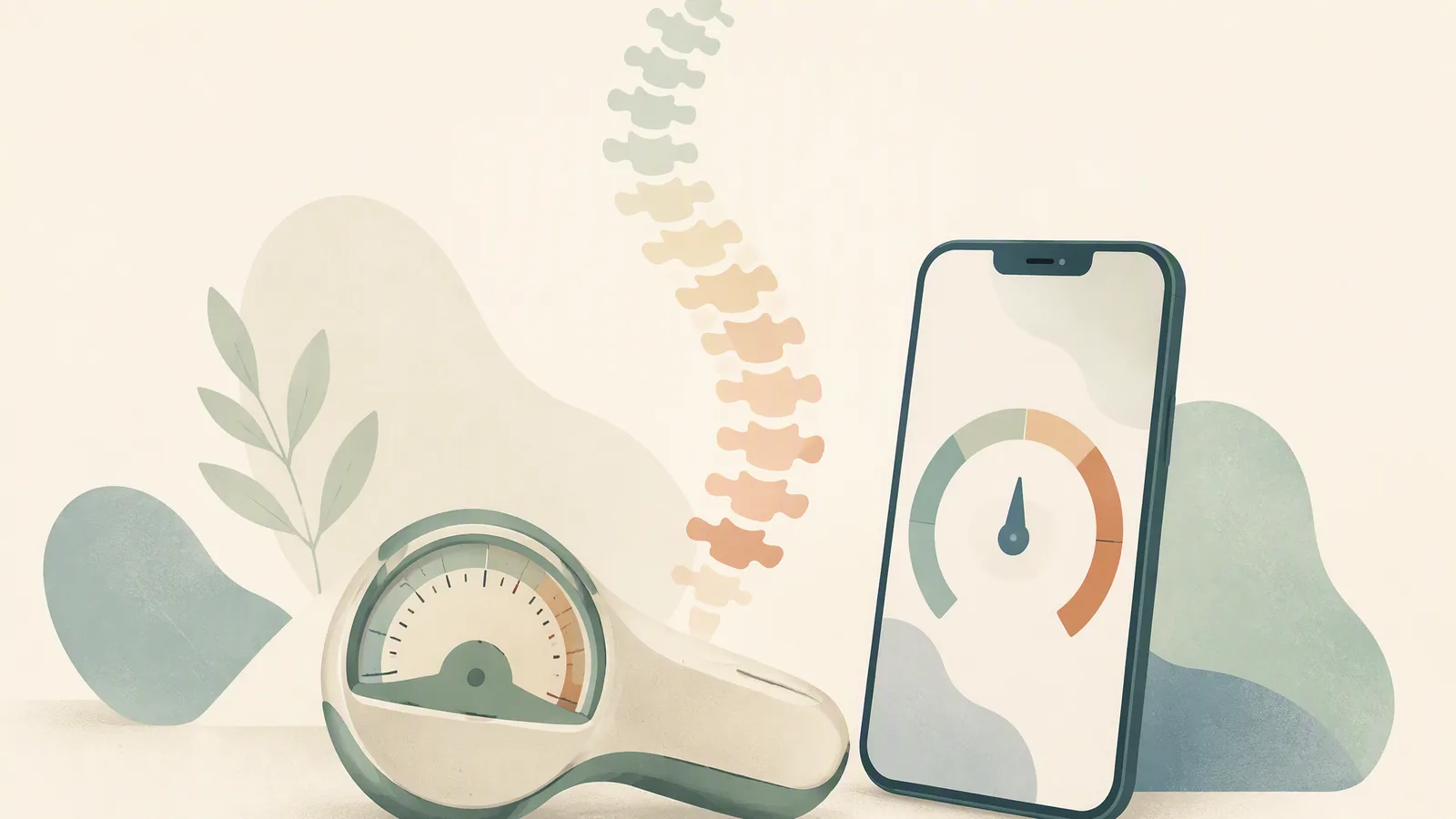
If a school nurse, physical therapist or parent has ever asked a child to bend forward and touch their toes while watching the back, they were performing the screen a scoliometer is built for. The instrument puts a number on what the eye is trying to judge: how much one side of the trunk is raised relative to the other. This page explains exactly what that number means, what it does not mean, and when a reading should prompt a professional visit.
What a scoliometer actually measures
Scoliosis is a three-dimensional condition. The spine bends sideways, but the vertebrae also rotate. That rotation pushes the ribs and muscles on one side further back, so when a person bends forward, one side of the trunk sits higher than the other. A scoliometer, laid flat across the back, measures the angle of that difference — the Angle of Trunk Rotation, or ATR, in degrees.
A digital scoliometer app does the same thing using the motion sensors already inside a smartphone, so no separate physical instrument is needed. The Scoliometer App reads ATR across the thoracic and lumbar regions and records the highest value.
ATR is not the Cobb angle
The most common confusion is between the ATR and the Cobb angle. They describe different things, and mixing them up leads to false reassurance or unnecessary worry.
| Angle of Trunk Rotation (ATR) | Cobb angle |
|---|---|
| Measured on the surface of the back with a scoliometer | Measured on an X-ray of the spine |
| Captures trunk rotation | Captures the spine’s sideways curve |
| A screening indicator | The diagnostic measurement |
| Anyone can take it, at home or in clinic | Requires imaging and clinical interpretation |
Screening research suggests the two are related — a higher ATR tends to accompany a larger spinal curve — but the relationship is approximate and varies between individuals. A scoliometer reading points toward whether an X-ray is worth taking; it never substitutes for one.
Physical scoliometer vs digital scoliometer app
A traditional scoliometer is an inexpensive plastic instrument with a rolling ball or fluid level. A digital scoliometer app reproduces the measurement with a phone’s sensors. Both measure ATR; the practical differences are convenience, record-keeping and consistency.
| Physical scoliometer | Digital app | |
|---|---|---|
| What it measures | ATR | ATR |
| Record keeping | Manual notes | Readings can be logged and tracked over time |
| Availability | Purpose-bought tool | Already in your pocket |
| Consistency | Depends on tester | Depends on tester; on-screen guidance can help |
How to read the numbers
These are widely used screening thresholds, not diagnoses:
- Below 5° — generally considered low; keep monitoring at regular intervals, especially during a child’s growth spurt.
- 5°–6° — worth attention, and a lower referral threshold applies to heavier children, in whom curves are more easily missed.
- 7° or more — the commonly accepted threshold for referral to a healthcare professional.
- A rising trend — an increase of 2° or more between measurements warrants review even if the absolute number still looks modest. Progression matters as much as any single reading.
Scoliosis screening in the United States
There is no single national scoliosis screening program in the United States. In 2018 the U.S. Preventive Services Task Force reviewed adolescent idiopathic scoliosis in children and adolescents aged 10 to 18 and issued a Grade I statement, meaning the current evidence is insufficient to weigh the benefits and harms of routine screening. A Grade I is not a finding that screening is harmful — it is a finding that the evidence does not settle the question.
In practice, requirements are set state by state. States including Pennsylvania, California, Georgia and Minnesota have school scoliosis screening rules, while others leave detection to routine pediatric well-child visits. Because of that patchwork, many curves are first noticed at home by a parent rather than at school. A scoliometer reading gives you an objective number to bring to a pediatrician, whichever state you live in.
When a reading needs professional review
Seek an assessment if a reading reaches the referral threshold, if readings are climbing over time, or if you also notice uneven shoulders, a prominent shoulder blade, an uneven waistline or a visible rib hump on forward bending. A scoliometer is there to help you make that decision earlier — not to make it for you. When in doubt, consult a professional.
Download the Scoliometer App
Available on iPhone and Android.

 Trusted by clinicians and families in 75+ countries.
Frequently asked questions
- Does a scoliometer measure the Cobb angle?
- No. It measures the Angle of Trunk Rotation on the surface of the back. The Cobb angle is measured on an X-ray by a clinician.
- Can a scoliometer diagnose scoliosis?
- No. It is a screening aid. A diagnosis requires a professional examination, usually with imaging.
- What scoliometer reading is a concern?
- About 7° is the usual referral threshold (6° for overweight and 5° for obese children), but a rising trend at any level is also a reason to seek review.
- Can parents use a scoliometer at home?
- Yes. The forward-bend screen is simple to perform, and home monitoring between clinic visits is a common, appropriate use.
Related guides
- How to use a scoliometer — step-by-step technique for a reading you can repeat.
- What is a normal scoliometer reading? — the 5° and 7° screening thresholds explained.
- ATR versus Cobb angle — why a surface measurement cannot replace an X-ray.
- Adam’s Forward Bend Test — the screening position the measurement is taken in.
Reference: van West HM, Herfkens J, Rutges JPHJ, Reijman M. The smartphone as a tool to screen for scoliosis, applicable by everyone. European Spine Journal 2022;31(4):990–995. The study measured 50 adolescents already diagnosed with idiopathic scoliosis (44 girls; mean age 14.1 years; mean Cobb angle 38.5°) at a hospital outpatient orthopaedic clinic, not children being screened at home. It validated smartphone-based ATR measurement as a method rather than any bespoke scoliosis app.

