Last reviewed: 15 August 2026. This guide is educational and does not replace individual assessment by a qualified clinician. Translations of this guide are made from this English original, which is the medically reviewed source.
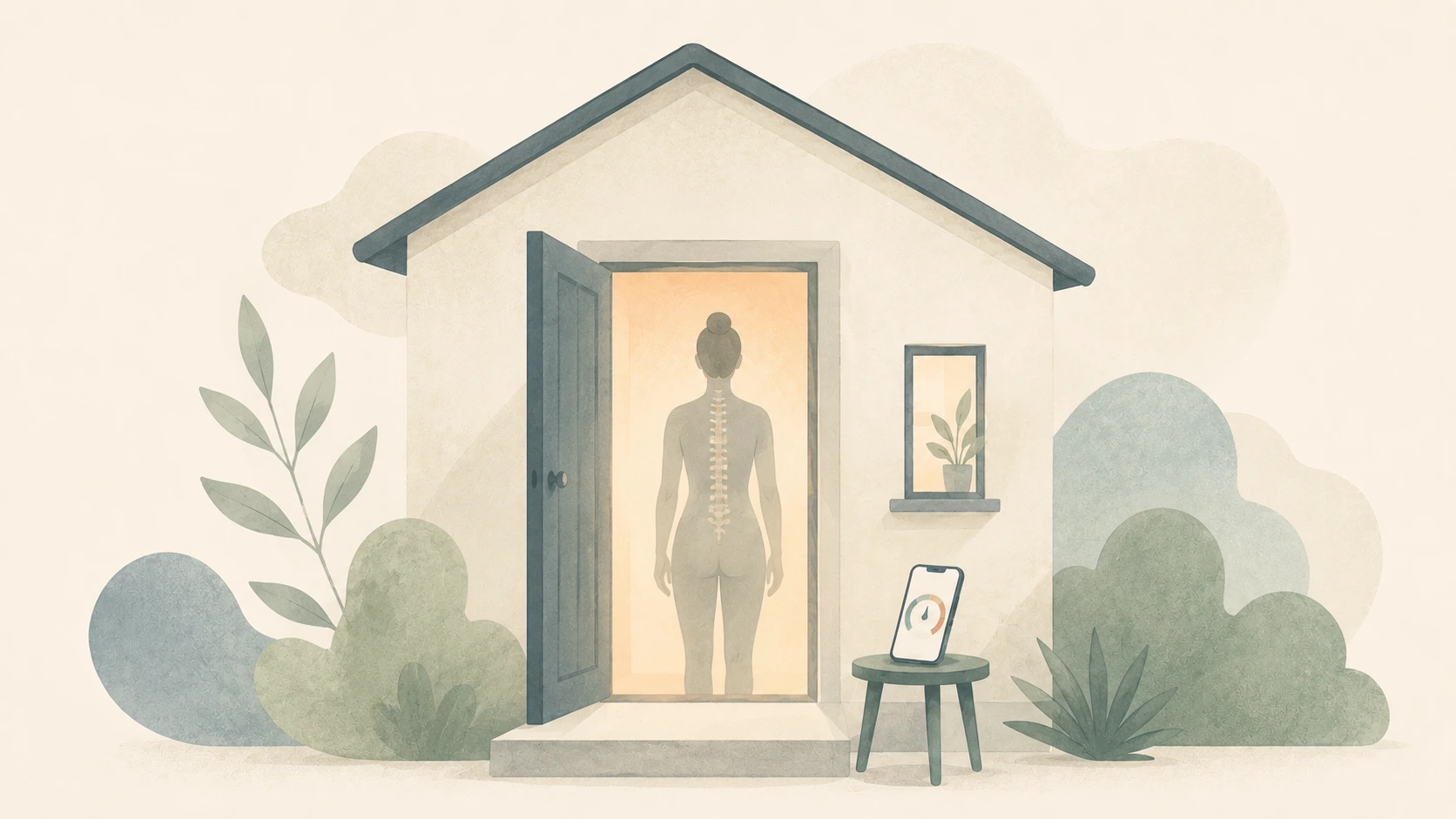
A home check is one of the simplest ways to catch a possible spinal asymmetry early — and early awareness matters, because curves are easier to monitor and manage when they are found before they progress. But “checking at home” is often misunderstood. It is a screening step, meant to help you decide whether to seek a professional opinion. It is not a way to diagnose scoliosis, and it cannot measure the Cobb angle, which requires an X-ray read by a clinician.
This guide walks you through a safe, calm, repeatable home screen: what to look for, how to add an objective Angle of Trunk Rotation (ATR) reading with a smartphone scoliometer, how to read the result sensibly, and — most importantly — when to stop screening and see a professional.
What a home check can and cannot tell you
A smartphone scoliometer and the visual checks below assess the surface of the back — the asymmetry and trunk rotation you can see and measure without imaging. That is genuinely useful for spotting when something deserves a closer look. What they cannot do is measure the actual sideways curve of the spine (the Cobb angle), confirm a diagnosis, or tell you the cause. Those answers come from a clinician, usually with an X-ray.
| A home check CAN | A home check CANNOT |
|---|---|
| Reveal visible asymmetry (shoulders, waist, ribs) | Diagnose scoliosis |
| Give an objective ATR (trunk rotation) reading | Measure the Cobb angle |
| Track change over time with consistent technique | Replace an X-ray or clinical exam |
| Help you decide when to seek professional care | Identify the type or cause of a curve |
Before you start: setting up a good, calm check
- Good light and a plain background. Stand the person in front of a plain wall with even lighting so asymmetry is easy to see.
- Bare back or fitted clothing. The upper back should be visible. For a child, keep it comfortable and matter-of-fact — frame it as a quick posture check, not a medical test.
- Feet together, weight even, arms relaxed. Uneven stance can create asymmetry that is not really there.
- Same conditions each time. If you plan to repeat the check, use the same room, same time of day where possible, and the same person taking the measurement.
- Stay calm. Anxiety is contagious. Most asymmetries turn out to be minor, and the goal here is simply to know whether to book an appointment.
Step 1: The standing visual check
Stand behind the person and look for symmetry from head to hips. You are comparing the left and right sides. Look for:
Shoulders and neck
Is one shoulder higher than the other? Does the head sit centred over the pelvis, or does it lean to one side?
Shoulder blades
Does one shoulder blade (scapula) stick out or sit higher than the other?
Waist and hips
Is the gap between each arm and the waist uneven? Does one hip look higher, or the waistline asymmetrical?
Overall lean
Does the body lean or shift to one side rather than stacking evenly over the feet?
Any single finding on its own is common and often harmless. It is a pattern of asymmetry — or a clearly visible one — that suggests the next step is worthwhile.
Step 2: The Adam’s Forward Bend Test
This is the single most useful home screening movement, and it is what school and clinical screening programmes are built around. Ask the person to stand with feet together and knees straight, then slowly bend forward from the waist as if reaching for their toes, letting the arms hang and the palms come together. View the back from behind, at the level of the spine, with your eye low.
You are looking for a rib hump or a raised area on one side of the back — a sign of trunk rotation. A flat, level back is reassuring; a visible hump on one side is the signal to measure it objectively. For the full technique, positioning tips and limitations, see our dedicated Adam’s Forward Bend Test guide.
Step 3: Add an objective ATR reading
The eye is good at noticing asymmetry but poor at quantifying it. This is where a smartphone scoliometer helps. With the person still bent forward in the Adam’s position, rest the phone gently across the back, at right angles to the spine, at the point where the hump looks largest. The app measures the Angle of Trunk Rotation — how much one side of the trunk is raised relative to the other.
Move slowly along the back — upper (thoracic), middle and lower (lumbar) regions — and record the largest reading. Take it two or three times to be sure it is stable. An ATR reading is a measure of trunk rotation; it is not the Cobb angle and it cannot diagnose scoliosis, but it turns “that looks a bit uneven” into a number you can track and act on.
How to read the result
Clinicians use widely recognised screening thresholds for the Angle of Trunk Rotation. Use them as a guide to your next step, not as a diagnosis:
| ATR reading | What it generally suggests |
|---|---|
| Under 5° | Low. Continue routine observation; recheck periodically during growth. |
| 5°–6° | Worth attention. Repeat carefully and monitor; consider professional advice, especially in a rapidly growing child. |
| 7° or more | A common threshold to seek a professional assessment. |
| A repeated, confirmed rise between checks | Warrants professional review even if the absolute number seems modest. |
Remember that results vary from person to person and depend on technique, the phone, and who is taking the reading. A trend measured consistently over time is far more meaningful than any single number. When in doubt, ask a professional — see when a scoliometer reading needs professional review.
Special situations
Children and teenagers during growth spurts
Adolescent curves can change fastest during the growth spurt, so this is the most important time to screen and re-screen. See scoliosis screening during growth spurts for timing and what to watch.
Adults
Adults can have scoliosis too — either a curve carried from adolescence or a degenerative curve that develops later. The same visual checks and ATR reading apply, though adults are more likely to notice back pain, stiffness or posture change than a growing rib hump. A new or progressing asymmetry in an adult is worth a professional opinion.
When to see a professional
Book an assessment if you notice any of the following, rather than waiting:
- A visible rib hump or a clear, one-sided raised area on forward bending.
- An ATR reading of 7° or more, or a rise that repeats across careful, consistent checks.
- A pattern of asymmetry — uneven shoulders, waist and hips together.
- Any asymmetry that is new, increasing, or accompanied by pain.
A professional assessment is the only way to confirm or exclude scoliosis and to decide whether any treatment or monitoring is needed. Screening at home simply helps you get there at the right time.
Screen at home with the Scoliometer App
Measure the Angle of Trunk Rotation on iPhone or Android, and keep a record you can track over time. A screening aid — not a diagnostic tool.


Frequently asked questions
Can I diagnose scoliosis at home?
No. A home check is a screening step, not a diagnosis. It can help you decide whether to seek a professional assessment, but only a clinician — usually with an X-ray — can confirm scoliosis and measure the Cobb angle.
What is a normal reading on a scoliometer app at home?
Readings below 5° of Angle of Trunk Rotation are generally considered low. A reading of 5° to 6° deserves attention and repeat monitoring, and 7° or more is a common threshold to seek a professional assessment. These are screening guides, not diagnostic cut-offs.
How often should I check for scoliosis at home?
For a growing child or teenager, checking every few months during the peak growth years is reasonable. Keep the same technique and, ideally, the same person taking the measurement so that changes over time are meaningful. Seek advice sooner if you notice a clear or increasing asymmetry.
Is checking for scoliosis at home safe?
The visual checks and an ATR reading are non-invasive and involve no radiation, so they are safe to do at home. The main risk is misinterpreting the result — either causing unnecessary worry or giving false reassurance. Use a home check to decide whether to seek professional care, not to rule scoliosis in or out.
My child’s reading was raised once but normal the next time. What now?
Single readings vary with technique and positioning. Repeat carefully over the coming weeks using the same method. If a raised reading recurs, reaches 7° or more, or is accompanied by visible asymmetry, arrange a professional assessment rather than continuing to re-measure at home.
Medical disclaimer: This guide is for general education and screening awareness only. It is not medical advice and does not diagnose scoliosis or any spinal condition. A scoliometer — including a smartphone scoliometer — measures the Angle of Trunk Rotation as a screening aid; it is not the same as the Cobb angle, and it cannot replace an X-ray or professional assessment. Results vary between individuals depending on age, skeletal maturity, curve type, body build, measurement technique and how consistently readings are taken. Always consult a qualified healthcare professional about your own or your child’s spine.

