Last reviewed: 15 August 2026. This guide is educational and does not replace individual assessment by a qualified clinician. Translations of this guide are made from this English original, which is the medically reviewed source.
A scoliometer is a simple tool, but a reading is only as trustworthy as the way it was taken. Most of the confusion people run into — numbers that jump around, readings that seem too high or too low — comes down to a handful of avoidable technique errors. Here are the nine most common ones, and exactly how to fix each so your Angle of Trunk Rotation (ATR) readings are accurate and repeatable.
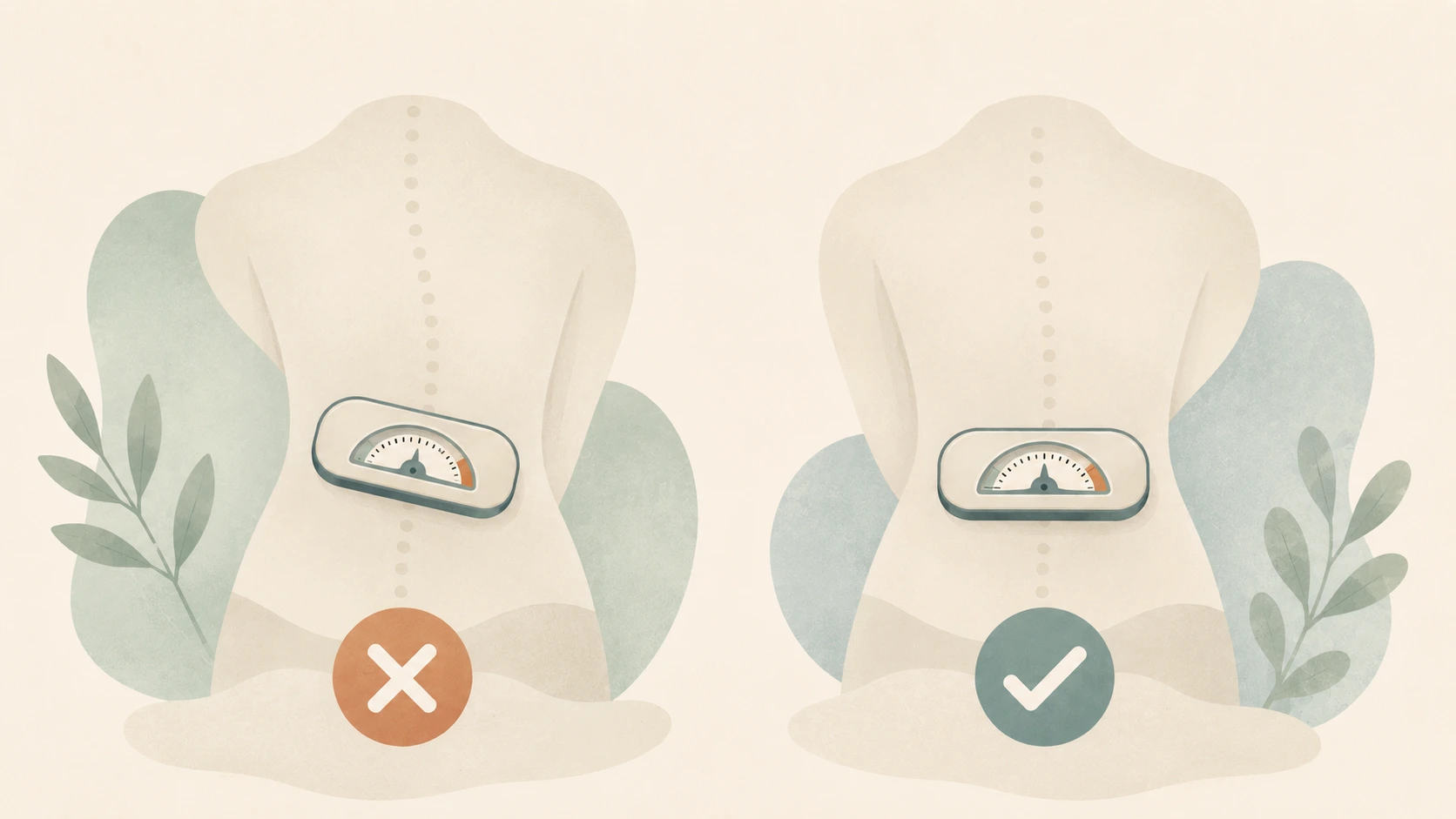
Why this matters. A scoliometer screens for trunk asymmetry by measuring ATR during the forward bend. Consistency is everything: the goal is a number you can trust today and compare fairly against next month’s. Careless technique doesn’t just give a wrong number once — it hides real change and creates false alarms.
The nine mistakes
1. The person isn’t bending far enough
Rotation only shows on the surface when the spine is flexed. A shallow bend flattens the rib hump and under-reads the ATR.
Fix: Have the person bend forward slowly from the waist until the back is roughly horizontal, feet together, knees straight, arms hanging loose with palms together. Adjust how far they bend so the apex of the curve is level with your eye.
2. Measuring only one spot instead of scanning the whole spine
Rotation can occur in the upper (thoracic) back, the lower (lumbar) back, or both. Checking a single level often misses the largest rotation.
Fix: Move the scoliometer slowly down the whole spine, from the neck to the lower back, while the person stays bent. Record the highest reading you find — that is the number that matters.
3. The device isn’t centred on the apex, or isn’t sitting flat
A scoliometer must straddle the spine at the peak of the hump, resting evenly on both sides. Tilting it, or placing it a little to one side, changes the reading.
Fix: Centre the device over the spinous process at the highest point of the rise, with the zero mark on the midline, and let it rest on the skin without pressing.
4. Not zeroing the phone, or using it on a case or angle
With a phone, a thick or uneven case, or starting a measurement while the phone is already tilted, throws the baseline off.
Fix: Use the app on a flat-backed phone, calibrate or zero it on a known level surface if the app offers it, and place it gently and squarely across the back. Keep the same phone for repeat measurements where possible.
5. A different person measures each time
Two people will bend the subject slightly differently and place the device slightly differently. Between-measurer variation is one of the biggest sources of “my numbers keep changing.”
Fix: Where you can, have the same person take every measurement. If that isn’t possible, agree on identical technique and note who measured.
6. Taking a single hurried reading
One rushed measurement is a snapshot that can easily be a degree or two off.
Fix: Take the reading two or three times in the same session and use the value you can reproduce, not the highest one-off spike. Give the person a moment to settle into the bend before you read.
7. Measuring over bunched or heavy clothing
Fabric folds and thick clothing sit unevenly on the back and lift the device off the skin.
Fix: Measure on bare skin or over a thin, smooth layer. Make sure nothing is bunched under the device.
8. Uneven floor or an asymmetric stance
If the person stands on a slope, shifts their weight, bends their knees or lets the feet drift apart, the trunk tilts for reasons that have nothing to do with the spine.
Fix: Use a level floor. Feet together and flat, weight even, knees straight, and the head and arms relaxed straight down.
9. Treating the number as a diagnosis — or not writing it down
The two opposite errors: reading too much into a single figure, and failing to record readings so you can never see the trend.
Fix: Log every reading with the date. A scoliometer screens for asymmetry; it does not diagnose. Use the series of readings to spot change, and see a clinician if a number is raised or rising.
A quick pre-measurement checklist
| Before you read | What good looks like |
|---|---|
| Surface | Level floor; bare skin or a thin smooth layer |
| Stance | Feet together and flat, weight even, knees straight, arms hanging with palms together |
| Bend | Slow bend from the waist until the back is horizontal at the apex |
| Device | Zeroed, flat-backed phone; centred on the midline at the peak of the hump |
| Scan | Whole spine, neck to lower back; record the highest reading |
| Repeat | Same measurer, two or three readings, log the reproducible value with the date |
For the full step-by-step, see how to use a scoliometer. To understand how much natural variation to expect even with perfect technique, see how accurate smartphone scoliometers are.
How much does good technique actually change the number?
Studies of smartphone-based ATR measurement have generally reported good agreement with a physical scoliometer and good repeatability — but that reliability depends on consistent technique. Those studies evaluated the ATR method across a range of apps and examiners rather than any single application, including this one. The practical message is that the tool can be dependable; most of the error people see is introduced by how the reading is taken, which is exactly what the fixes above are designed to remove.
Frequently asked questions
What is the single most common scoliometer mistake?
Measuring only one spot on the back instead of scanning the whole spine. Rotation can appear in the upper or lower back, and checking one level often misses the largest reading. Always scan from neck to lower back and record the highest value.
Why does my reading change every time?
Usually because of small differences in the bend, device placement, the spinal level measured, or a different measurer. Standardise the technique, keep the same measurer where possible, and take two or three readings per session.
Do I need to measure on bare skin?
Bare skin or a thin, smooth layer is best. Bunched or heavy clothing sits unevenly and lifts the device off the back, changing the reading.
Does a phone case affect the measurement?
It can. A thick or uneven case stops the phone sitting flat. Use a flat-backed phone, zero it on a level surface if the app allows, and place it squarely across the midline.
How many times should I measure in one session?
Two or three times. Use the value you can reproduce rather than a single reading, and let the person settle into the bend before you read.
Which reading do I record if I get different numbers at different levels?
Record the highest ATR found while scanning the whole spine. That is the value that best reflects the largest rotation.
Can I measure someone by myself, or do I need help?
You measure another person; a scoliometer is used on someone who is bending forward, so you generally cannot reliably measure your own back. Having the same helper each time improves consistency.
If my technique is good, is the reading a diagnosis?
No. Even a careful reading is a screening measurement of trunk asymmetry, not a diagnosis. A raised or rising number is a reason to see a clinician, who can confirm what is happening, usually with an X-ray.
Get repeatable readings, every time
The Scoliometer App measures the Angle of Trunk Rotation and logs each reading with the date, so consistent technique turns into a trend you can actually track. A screening aid — not a diagnostic tool.


Medical disclaimer: This guide is for general education and screening awareness only. It is not medical advice and does not diagnose scoliosis or any spinal condition. A scoliometer — including a smartphone scoliometer — measures the Angle of Trunk Rotation as a screening aid; it is not the same as the Cobb angle, and it cannot replace an X-ray or professional assessment. Results vary between individuals depending on age, skeletal maturity, curve type, body build, measurement technique and how consistently readings are taken. Always consult a qualified healthcare professional about your own or your child’s spine.

