Last reviewed: 15 August 2026. This guide is educational and does not replace individual assessment by a qualified clinician. Translations of this guide are made from this English original, which is the medically reviewed source.
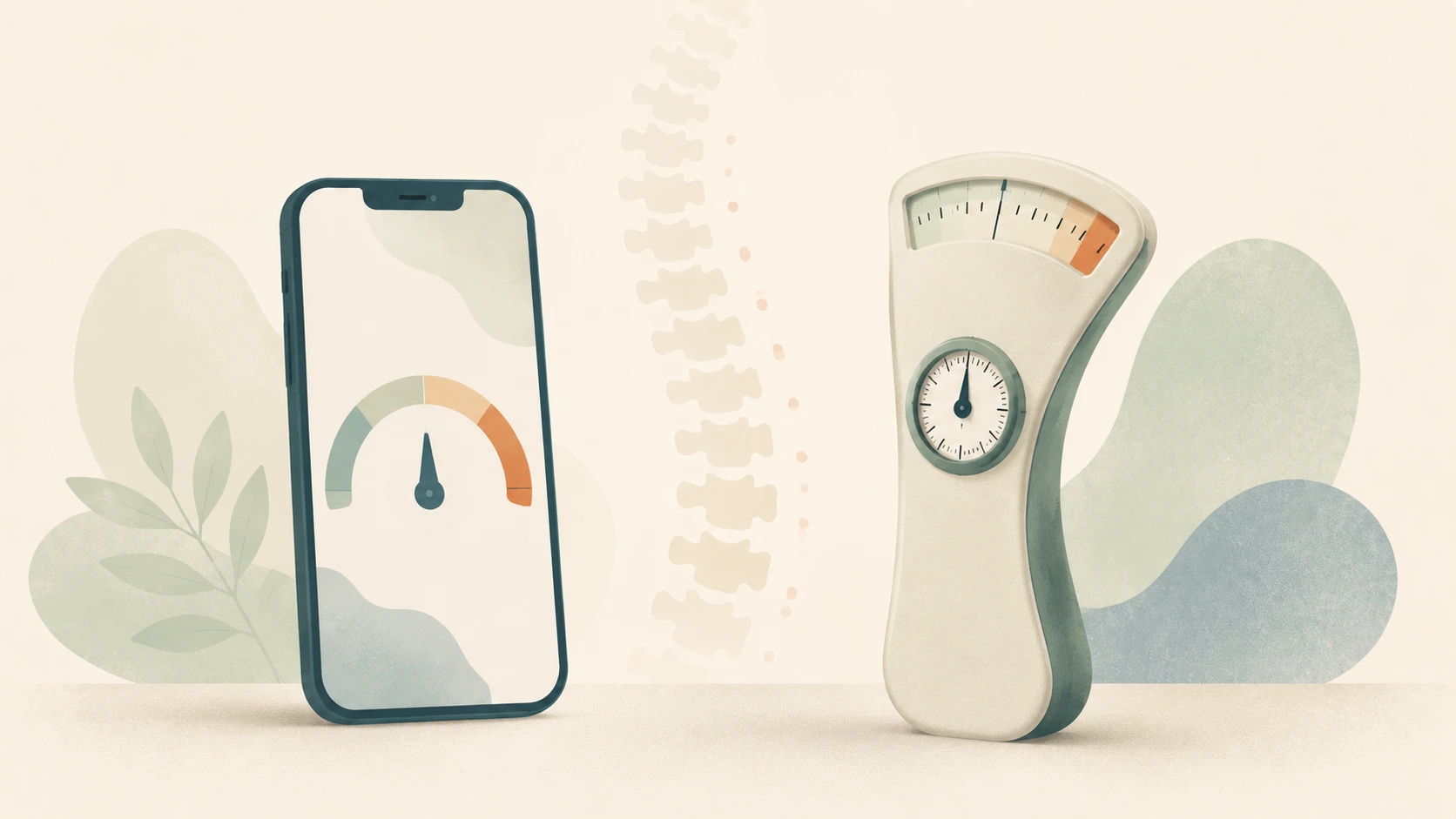
If you are choosing a way to screen for scoliosis, you will meet two kinds of scoliometer: the classic physical (Bunnell-type) instrument used in clinics and schools for decades, and the newer digital smartphone scoliometer. Both measure the same thing — the Angle of Trunk Rotation (ATR) during the Adam’s Forward Bend Test. This guide explains how each works, where each is stronger, and how to get a reliable reading whichever you use.
What both devices actually measure
Scoliosis involves a three-dimensional change in the spine, and one of its visible signs is a rotation of the trunk — most often seen as one side of the back or ribcage sitting higher than the other when a person bends forward. A scoliometer is placed across the back at the point of greatest asymmetry and reports the angle of that rotation in degrees. That number is the ATR.
It is important to be precise about what the ATR is not. The ATR is not the Cobb angle, the measurement radiologists take from an X-ray to describe the sideways curve of the spine. A scoliometer — physical or digital — estimates surface trunk rotation, not the underlying spinal curve, so it cannot replace an X-ray or a clinical examination. For the full distinction, see ATR vs Cobb Angle.
The physical scoliometer
The physical scoliometer is a moulded, gravity-based inclinometer — the best-known example is the Bunnell scoliometer. It has a channel that rests on the back and a rolling ball or fluid level that settles to show the angle on a printed scale. There is no battery and no software.
Strengths
It is simple, durable and inexpensive to run once purchased, needs no charging, and is a long-established tool that many clinicians and school-screening programmes already know and trust. Because the scale is fixed, there is nothing to calibrate in software.
Limitations
A physical device has to be bought, stored and carried; readings are taken by eye off a small scale, so they depend on the examiner’s line of sight and are not automatically recorded; and sharing or tracking results over time means writing numbers down by hand.
The digital (smartphone) scoliometer
A digital scoliometer uses the orientation sensors already built into a smartphone to measure the same tilt, and shows the ATR on screen. The Scoliometer App works this way and reports the angle across a 0–50° range.
Strengths
Most people already carry a capable device, so there is nothing extra to buy or keep charged separately; the reading is shown clearly on screen and can be noted and re-checked easily; and an app can guide correct positioning and make it simple to record measurements over months so a parent or clinician can watch for change. Peer-reviewed research on smartphone-based ATR measurement has reported good agreement with the physical scoliometer for screening purposes.
Limitations
Accuracy depends on the phone being held flat and steady on the back and on the sensors being uncalibrated by a heavy case; results still need to be interpreted sensibly; and, as with the physical device, a digital reading is a screening signal, not a diagnosis.
Side-by-side comparison
| Physical (Bunnell-type) | Digital (smartphone) | |
|---|---|---|
| What it measures | Angle of Trunk Rotation (ATR) | Angle of Trunk Rotation (ATR) |
| How you read it | By eye, off a printed scale | On the phone screen |
| Recording & tracking | Manual notes | Can be logged and re-checked in the app |
| Cost & upkeep | One-off purchase; no power | Uses a phone you already own |
| Portability | Separate instrument to carry | Always with you |
| Best suited to | Established clinic/school programmes | Home checks, telehealth, easy repeat monitoring |
| Measures Cobb angle? | No | No |
| Can diagnose scoliosis? | No — screening aid | No — screening aid |
Which should you choose?
For an established clinic or a school programme that already owns and trusts a Bunnell scoliometer, there is no need to replace it. For a parent checking a child at home, a clinician working across sites, or anyone who wants to record readings and watch for change over time, a digital scoliometer is convenient because the phone is already there and the results are easy to keep. Many practitioners simply use whichever is to hand — the measurement being taken is the same.
Getting a reliable reading
Whichever scoliometer you use, technique matters more than the brand. Have the person bend forward slowly with knees straight, feet together and arms hanging; find the point of greatest asymmetry across the thoracic and lumbar back; rest the device gently without pressing; and record the highest value you see. The same person taking each measurement, in the same position, makes month-to-month comparisons far more meaningful. Our step-by-step walkthrough is in How to Use a Scoliometer, and the frequent slips to avoid are in Common Scoliometer Measurement Mistakes.
Measure the Angle of Trunk Rotation on the phone you already carry, and keep a record over time.


Frequently asked questions
Is a digital scoliometer as accurate as a physical one?
Peer-reviewed research on smartphone-based ATR measurement has reported good agreement with the physical scoliometer for screening. That research assessed the method and various apps rather than any one specific application, so a digital scoliometer is best understood as a research-informed screening aid, not a clinically-validated replacement device.
Does either device measure the Cobb angle?
No. Both measure the Angle of Trunk Rotation on the surface of the back. The Cobb angle is measured from an X-ray by a clinician. A scoliometer reading cannot be converted into a Cobb angle.
Can a scoliometer diagnose scoliosis?
No. A scoliometer — physical or digital — is a screening tool. A raised reading suggests that a professional assessment is worthwhile; only a clinician, usually with imaging, can diagnose scoliosis.
What is a Bunnell scoliometer?
The Bunnell scoliometer is the most widely known physical scoliometer: a moulded gravity inclinometer laid across the back during the forward-bend test to read trunk rotation off a printed scale.
Do I need a special phone case or attachment?
No attachment is required. A thin case is usually fine; a thick or uneven case can hold the phone off the back and skew the reading, so remove it if in doubt and rest the phone flat against the skin or a thin layer of clothing.
Which is better for tracking changes over time?
A digital scoliometer makes repeat monitoring easier because readings can be recorded and compared in the app. With a physical device you can do the same by writing each reading down carefully with the date.
Medical disclaimer: This guide is for general education and screening awareness only. It is not medical advice and does not diagnose scoliosis or any spinal condition. A scoliometer — including a smartphone scoliometer — measures the Angle of Trunk Rotation as a screening aid; it is not the same as the Cobb angle, and it cannot replace an X-ray or professional assessment. Results vary between individuals depending on age, skeletal maturity, curve type, body build, measurement technique and how consistently readings are taken. Always consult a qualified healthcare professional about your own or your child’s spine.

