Last reviewed: 15 August 2026. This guide is educational and does not replace individual assessment by a qualified clinician. Translations of this guide are made from this English original, which is the medically reviewed source.
The Angle of Trunk Rotation, or ATR, is the single number at the heart of scoliosis screening. It describes how much the trunk twists to one side, measured with a scoliometer while a person bends forward. This complete guide explains what the ATR is, how it is measured, what the numbers mean, how it differs from the Cobb angle, and where to go next for each part of the screening journey.
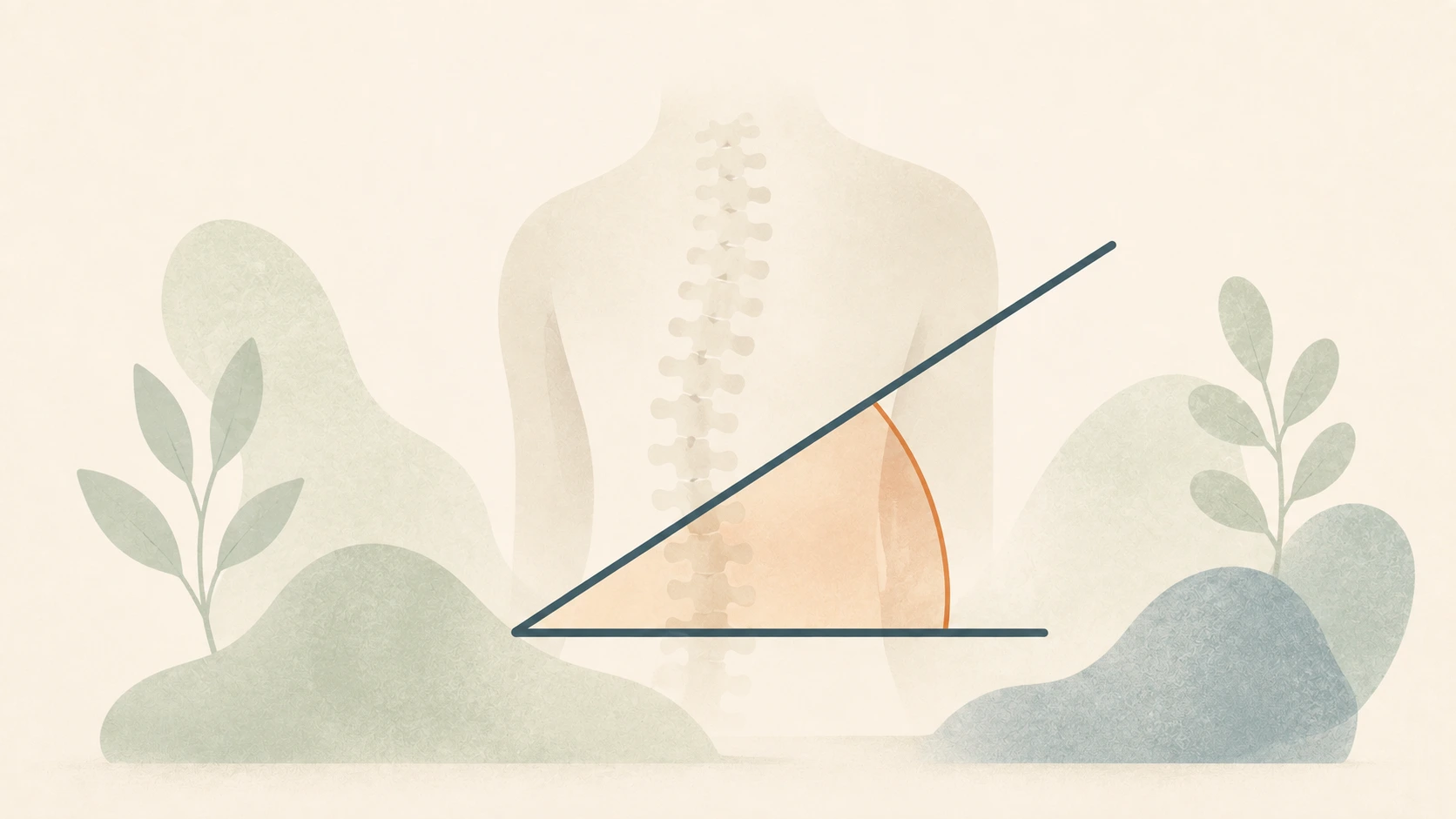
What is the Angle of Trunk Rotation?
When the spine curves and rotates, the ribcage and the muscles either side of the spine no longer sit symmetrically. Bending forward exaggerates this: on one side the back rises into a small hump while the other side drops. The ATR is the angle of that left-to-right tilt, measured in degrees across the highest point of asymmetry. A perfectly level back reads close to 0°; the more the trunk is rotated, the higher the ATR.
Because the ATR is measured on the surface of the body, it reflects trunk rotation rather than the exact shape of the spine underneath. That is why it is a screening measure: a useful, quick, non-invasive signal that says “this is worth a closer look” — not a diagnosis.
How the ATR is measured
The ATR is taken during the Adam’s Forward Bend Test. The person bends forward from the hips with knees straight, feet together and arms hanging freely, so the back is roughly horizontal. A scoliometer — a physical Bunnell-type device or a smartphone scoliometer — is laid gently across the back at right angles to the spine, and moved along the thoracic and lumbar regions to find the point of greatest asymmetry. The highest angle seen is recorded as the ATR.
Step-by-step technique is covered in How to Use a Scoliometer, and the errors that most often distort a reading are in Common Scoliometer Measurement Mistakes.
What ATR readings mean
ATR values are interpreted against widely used screening thresholds. These are guides for deciding whether to seek assessment, not diagnostic cut-offs.
| ATR reading | General interpretation |
|---|---|
| Under 5° | Generally low; routine re-checking is usually enough, especially during growth. |
| 5–6° | Deserves attention and closer monitoring; a common referral point for children who are overweight, where the back is harder to assess by eye. |
| 7° or more | A widely used threshold for arranging a professional assessment. |
| A repeated, confirmed rise | A reading that is higher on more than one occasion, taken the same way each time, is worth reviewing — even if the absolute number is modest. Repeat measurements of the same back can differ by several degrees, so a single higher reading is not by itself evidence of change. |
What a specific reading such as 5°, 7° or 10° means in context is explained in What Is a Normal Scoliometer Reading?, and the point at which a result should be reviewed by a clinician is covered in When to Seek Professional Assessment.
ATR vs the Cobb angle
This is the most important distinction to understand. The ATR is a surface measurement of trunk rotation taken with a scoliometer. The Cobb angle is measured by a clinician from a spinal X-ray and describes the sideways curvature of the spine itself. They are related — a larger curve tends to produce more rotation — but they are not the same number, and one cannot be reliably converted into the other. A scoliometer can never report a Cobb angle. The full comparison, including why the two can sometimes move independently, is in ATR vs Cobb Angle.
Why the ATR matters for early screening
Scoliosis often progresses fastest during growth spurts, and early curves can be easy to miss. Because measuring the ATR is quick, painless and needs no imaging, it is well suited to repeated screening at home, in schools and in clinics — the settings where change over time is most likely to be caught early. The value of the ATR is less in any single reading and more in a consistent series of readings taken the same way over time.
Use the Scoliometer App to measure the Angle of Trunk Rotation and keep a record you can compare over time.


The ATR guides, in order
- Adam’s Forward Bend TestThe screening position in which the ATR is measured.
- How to Use a ScoliometerStep-by-step technique for a reliable reading.
- What Is a Normal Scoliometer Reading?How to interpret the number you get.
- ATR vs Cobb AngleWhy surface rotation is not the spinal curve.
- When to Seek Professional AssessmentThe point at which a reading should be reviewed.
Frequently asked questions
What is the Angle of Trunk Rotation (ATR)?
The ATR is the angle of left-to-right tilt of the trunk, measured in degrees with a scoliometer across the point of greatest asymmetry while a person bends forward. It reflects trunk rotation on the surface of the body.
Is the ATR the same as the Cobb angle?
No. The ATR is a surface measurement of trunk rotation taken with a scoliometer. The Cobb angle is measured from an X-ray and describes the curvature of the spine itself. They are related but not interchangeable, and a scoliometer cannot report a Cobb angle.
What ATR reading is considered raised?
Under 5° is generally low, 5–6° deserves attention, and 7° or more is a widely used threshold for arranging a professional assessment. A reading that is repeatedly higher across careful, consistent measurements is also worth reviewing. These are screening guides, not diagnoses.
Can measuring the ATR diagnose scoliosis?
No. The ATR is a screening measurement. A raised reading suggests that a professional assessment is worthwhile; only a clinician, usually with imaging, can diagnose scoliosis.
How is the ATR measured at home?
During the Adam’s Forward Bend Test, a scoliometer — including a smartphone scoliometer — is laid across the back and moved to find the largest angle. The highest value is the ATR. The same person taking each reading the same way makes tracking over time more meaningful.
Medical disclaimer: This guide is for general education and screening awareness only. It is not medical advice and does not diagnose scoliosis or any spinal condition. A scoliometer — including a smartphone scoliometer — measures the Angle of Trunk Rotation as a screening aid; it is not the same as the Cobb angle, and it cannot replace an X-ray or professional assessment. Results vary between individuals depending on age, skeletal maturity, curve type, body build, measurement technique and how consistently readings are taken. Always consult a qualified healthcare professional about your own or your child’s spine.

