Scoliosis Questions
from Parents in India
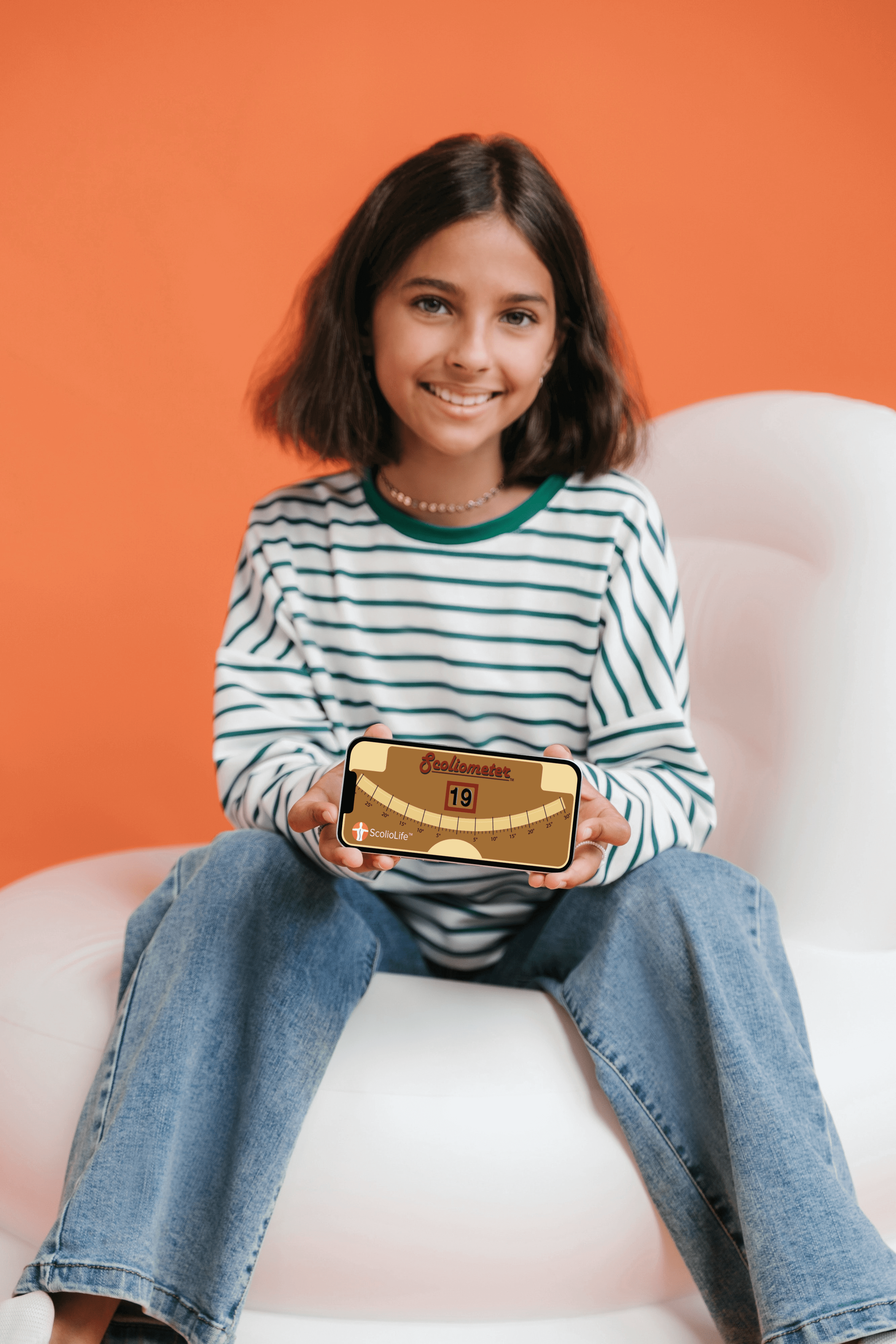
The app measures the Angle of Trunk Rotation, or ATR, using your phone’s motion sensors. You lay the phone across the back during the forward bend test and it reads the difference in height between one side of the trunk and the other, in degrees.
That difference comes from rotation of the vertebrae, which pushes the ribs and muscles on one side further back. It is a screening measurement, not a diagnosis.
There is no national school screening programme, and published prevalence data for Indian school populations remains limited.
In practice this means a curve is usually noticed at home, or during a consultation for something else. Some schools and hospitals run their own camps, so it is worth asking locally, but you should not assume anyone is checking.
A study of 1,076 adolescents aged 11 to 14 across six schools in south Bengaluru used the Adam’s forward bend test with a scoliometer, treating 7° or more as screen-positive and 5° to 6° as at risk. It found 1.6% screen-positive and 6.7% in the at-risk band, with higher rates in girls than boys, 2.01% against 1.04%, and in private schools than government schools, 1.98% against 0.37%.
Source: Kudva M, Nadgir A, Pruthviraj R, Studies in Health Technology and Informatics, 2026, DOI 10.3233/SHTI260758.
No, and it is important not to read it that way. A separate study of about 9,500 students in Jammu and Kashmir reported overall adolescent idiopathic scoliosis at 0.61%, and found it lower in girls, 0.31%, than boys, 0.88% — the opposite pattern to the Bengaluru finding.
Two regional studies with different results are not national data. Source: Singh H and colleagues, American Journal of Translational Research, 2022, PubMed PMID 35273713.
That screening rates vary by region, school type and study method, and that nobody has a reliable national figure yet.
What the Bengaluru study does show clearly is that a measurable number of children in an ordinary school population carry a raised reading nobody had noticed. That is the argument for checking your own child rather than for any particular statistic.
No. The Cobb angle is measured on a radiograph and can only come from an X-ray. The app measures rotation at the surface of the back.
The two are related but not interchangeable, and an ATR reading cannot be converted into a Cobb angle. See the difference between ATR and the Cobb angle.
It cannot. What it gives you is a measurement of trunk rotation, which is the same thing a screening camp measures and the same thing it acts on: a threshold for referring a child onward.
The diagnosis comes from a clinical examination and, where the doctor considers it necessary, an X-ray.
Have your child stand with feet together and knees kept straight, then bend forward from the hips with the arms hanging and the palms together, until the upper back is roughly level with the floor. Get down so your eye is level with the back rather than above it.
Lay the phone across the back at right angles to the spine, work from the top downwards, and keep the largest figure. Step-by-step photographs are in our forward bend test guide.
Across the back, centred on the spine, at right angles to it. Take one reading over the upper back, then have your child bend a little lower and take a second over the lower back.
Keep whichever is larger. A phone placed at a different height each time measures a different part of the back each time, and that alone can make a stable spine look as though it is changing.
Small readings are common and a perfectly symmetrical back is unusual. Under 5° is generally treated as within normal variation.
Stability over time matters as much as any single figure. See our guide to the normal scoliometer reading range.
The Bengaluru study used the same thresholds we do: 5° to 6° as a band worth watching, and 7° or more as screen-positive. Screening research reports that an ATR near 5° corresponds on average to a Cobb angle near 11°, and an ATR near 7° to a Cobb angle near 20°.
Those are group averages and an individual can sit well above or below them. ATR reading values explained covers this in full.
Consult if the reading is 5° or more, if it has risen by around 5° over a few months, if one shoulder blade or hip sits visibly higher, or if there is back pain, numbness or a change in how your child walks.
A paediatrician or an orthopaedic surgeon can examine the back and decide whether an X-ray is warranted. More in when to consult a specialist.
Your dated readings — date, which part of the back, the number, and who took the measurement.
A doctor seeing your child once cannot tell whether a curve is changing. A record covering several months answers a question the consultation itself cannot, and with no screening programme running it may be the only history available.
Once every three months is a sensible rhythm during the growth years for a child with no diagnosed curve. Where a doctor is already following a curve, their interval takes precedence over ours.
Measuring every week will not reveal a change any sooner. Curves move over months, so frequent readings mostly document the variability of the person holding the phone.
Yes, wherever that is practical. The app measures consistently; the differences between one session and the next come almost entirely from the person taking the reading — the depth of the bend, the placement of the phone, the pressure applied.
One measurer and one location at home will give you a record that actually tracks the spine rather than the method.
Yes. The reading is derived from the phone’s tilt, so a case with a protruding camera module or a raised edge lifts one side of the phone and builds that error into every measurement you take.
Remove the case where possible, or use the same one consistently. Do not press the phone into the back either, as compressing the tissue on the higher side understates the rotation.
A rising series matters more than any single value. An increase of roughly 5° between measurements is worth a doctor’s opinion even if the number still appears small.
Repeat the measurement carefully first and satisfy yourself that the method was unchanged, since technique alone can shift a reading by several degrees. If the increase persists, arrange a consultation. Progression is often painless and not visibly obvious.
Curves progress fastest during the adolescent growth spurt, and the Bengaluru study found higher rates in girls. A family history raises the likelihood.
Boys develop scoliosis too, and the Jammu and Kashmir study found it more often in boys than girls, so a boy with a visible rib hump is as worth measuring as a girl the same age.
Yes. Adults generally use it to keep track of a curve diagnosed earlier in life, or to quantify an asymmetry noticed along with back pain.
Change is slower in a mature spine, so measure at wider intervals and expect smaller movements. An asymmetry that has appeared recently, or that is moving quickly, should be assessed by a doctor rather than monitored at home.
Not by us. The app’s Data safety declaration on Google Play states that it collects no user data and shares none with third parties. Your readings stay on your own phone.
Because nothing is held on our servers, we cannot retrieve a lost history. Keep a written record alongside the app — date, part of the back, reading, and who measured — and carry it to consultations.
The store that took the payment issues the refund. In-app subscriptions are billed by Apple or Google, and only they are able to reverse a charge.
Write to Apple or Google support from the account used for the purchase. We have no access to their billing and cannot process it for you.
Yes, at no additional cost. Sign in using the same Apple ID or Google account that made the purchase and the app and your entitlement are restored.