Scoliosis Questions
from Parents in the UK
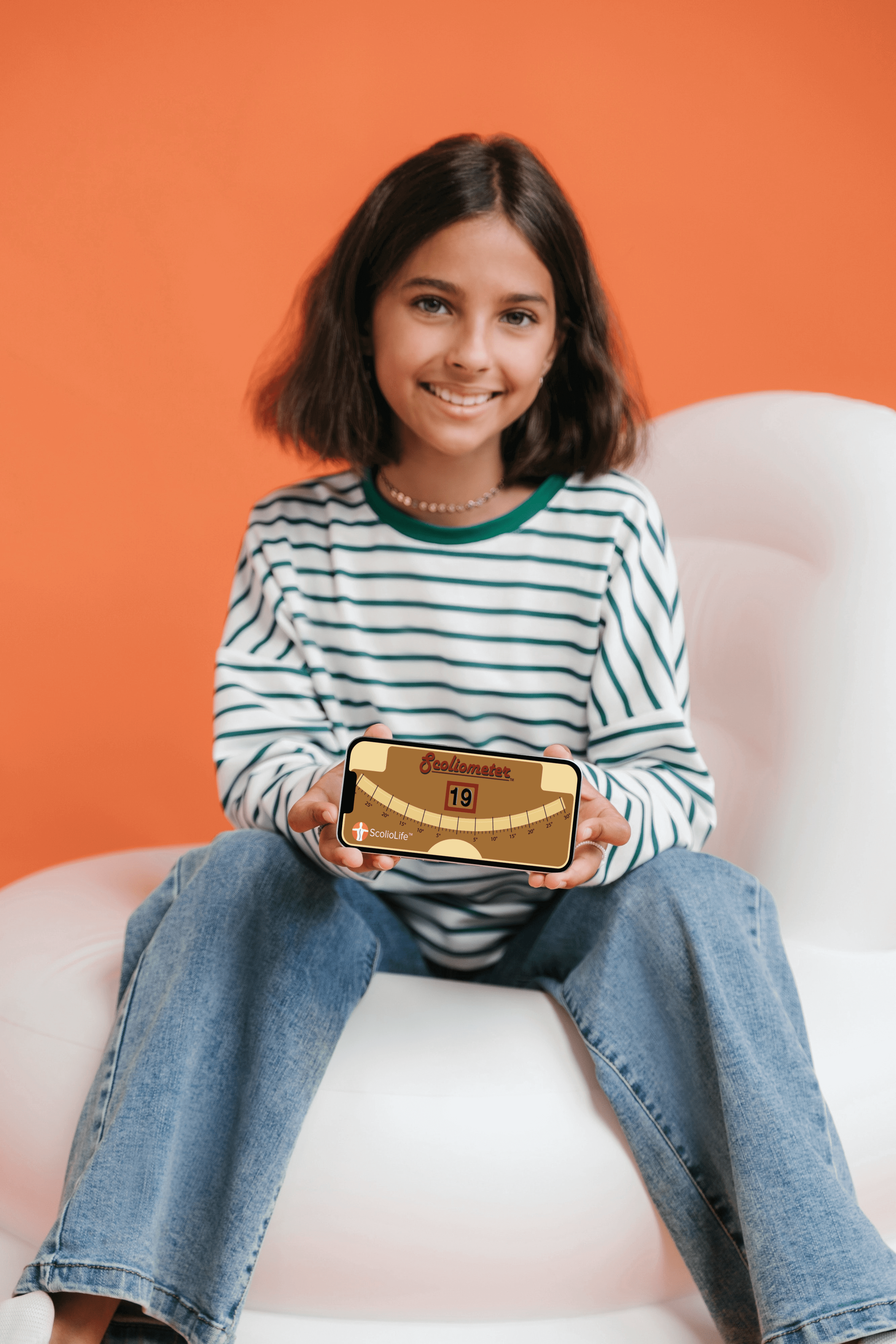
The app measures the Angle of Trunk Rotation, or ATR, using your phone’s motion sensors. You lay the phone across the back during the forward bend test and it reads the difference in height between one side of the trunk and the other, in degrees.
That difference is caused by rotation of the vertebrae, which pushes the ribs and muscles on one side further back. It is a screening measurement, not a diagnosis.
No. The UK National Screening Committee recommended against a national scoliosis screening programme in 2012 and reaffirmed that position in 2015. There is no school screening in the UK.
Policy is reviewed periodically, so check the current UK NSC position if you want the latest word.
Three reasons, and they are reasonable ones. Only about 8% of children who screen positive turn out to need treatment, so a national programme would send a great many healthy children for hospital assessment. There was no clear evidence that treating curves found by screening produces better outcomes than treating curves found in the normal way. And there were no agreed treatment guidelines for what to do with the curves screening would find.
That is a judgement about whether a national programme is worth running. It is not a statement that scoliosis does not matter.
No. The UK NSC decision is about the cost and benefit of screening every child in the country. It says nothing about whether an individual parent who has noticed something should look more carefully.
If you have a reason to check — a visible asymmetry, a family history, a child in the middle of a growth spurt — checking at home is sensible, and a measurement is more useful to a GP than an impression.
A number and a date. Without one you are comparing this month’s impression against last month’s memory, which is not a comparison at all.
Telling a GP that a reading has gone from 4° in February to 8° in August is a different conversation from saying your child’s back looks worse than it did.
No. The Cobb angle is measured on a radiograph and can only come from an X-ray. The app measures rotation at the surface of the back.
The two are related but not interchangeable, and an ATR reading cannot be converted into a Cobb angle. See ATR versus Cobb angle.
No. A raised reading tells you there is trunk asymmetry worth having examined. Confirming or ruling out scoliosis needs a clinical examination and, where indicated, imaging.
Use the reading to decide whether to book an appointment, not to decide what the diagnosis is.
Have your child stand with feet together and knees straight, then bend forward from the waist with arms hanging and palms together until the upper back is roughly level with the floor.
Look along the back from behind, lay the phone flat across the back at right angles to the spine, and work down from the top. Record the highest reading. Full instructions are in our forward bend test guide.
Flat across the back, centred on the spine and perpendicular to it. Take a reading over the upper back, then have your child bend a little further and take another over the lower back.
Record the largest number. Readings taken at a different level each time are not comparable, and that is the most common reason a series looks worrying when nothing has changed.
Small readings are common and a perfectly symmetrical back is unusual. Under 5° is generally treated as within normal variation.
Stability over time matters as much as any single figure. Our guide to what counts as a normal reading covers this properly.
Screening research reports that an ATR near 5° corresponds on average to a Cobb angle near 11°, and an ATR near 7° to a Cobb angle near 20°. These are group averages and an individual can sit well above or below them.
A reading cannot be converted into a Cobb angle. ATR readings explained sets out the thresholds and their limits.
Book if the reading is 5° or more, if it has risen by around 5° over a few months, if one shoulder blade or hip sits visibly higher, or if there is back pain, numbness or a change in how your child walks.
In the UK the GP is the gate. Referral to a paediatric spine service comes from there, so that appointment is the step that matters. More in when to see your GP.
Examine the back, usually with a forward bend test of their own, and decide whether imaging or a referral to a paediatric spine service is warranted.
Bring your dated readings. Because there is no screening programme in the UK, your record may be the only longitudinal information anyone has, and a GP seeing your child once cannot tell whether a curve is changing.
Say what you have measured and ask what threshold or change would prompt a referral. A specific number gives you both something to review against at a follow-up.
If you remain worried, you can ask for a second opinion. Keep measuring in the meantime, because a documented change is the most persuasive thing you can bring back.
Every three months through the growth spurt is a reasonable rhythm for a child with no known curve. If a curve is already being monitored, follow the interval the specialist has set.
Measuring weekly does not find change any earlier. It mostly records variation in your own technique.
Where possible, yes. Most of the difference between readings comes from how the phone is held and where it is placed, not from the app.
One person, the same room, the same time of day and the same phone gives you a series you can genuinely compare.
The measurement uses the phone’s motion sensors, so anything that tilts the device changes the number. A thick or uneven case is the usual cause and adds the same offset to every reading.
Measure with the phone flat against the back and, where possible, without a case. Pressing the phone in compresses soft tissue and tends to read low. Keep the setup identical between sessions.
A rising trend matters as much as any single reading. An increase of around 5° between measurements warrants professional review even if the absolute figure still looks modest.
First confirm the technique was identical, since method changes alone can move a reading by several degrees. If the increase holds on a careful repeat, book an appointment. Mild curves can progress without pain and without being obvious.
Curves progress fastest during the adolescent growth spurt, and more often in girls. A family history raises the likelihood.
Boys develop scoliosis too. Because nobody is screening in the UK, a boy with a visible rib hump is as worth measuring as a girl of the same age.
Yes. Adults use it to follow a curve they already know about, or to check trunk asymmetry alongside back pain.
Adult curves change more slowly than adolescent ones, so measure less often and expect smaller movements. A new or quickly changing asymmetry in an adult should be assessed by a doctor rather than tracked at home.
According to the app’s Data safety information on Google Play, the Scoliometer App collects no user data and shares none with third parties. Readings stay on your own device.
Because they are held on the device rather than on our servers, we cannot retrieve them for you. Keep your own dated record and bring it to appointments.
Subscriptions bought inside the app are billed by Apple or Google, and only they can refund them. We are not able to process a refund for a store purchase.
Contact Apple or Google support directly through the account you bought it with.
Yes. Download it again using the same Apple ID or Google account you bought it with and your purchase is restored at no extra cost.